
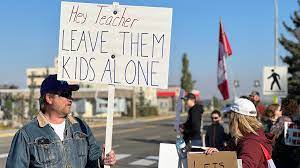
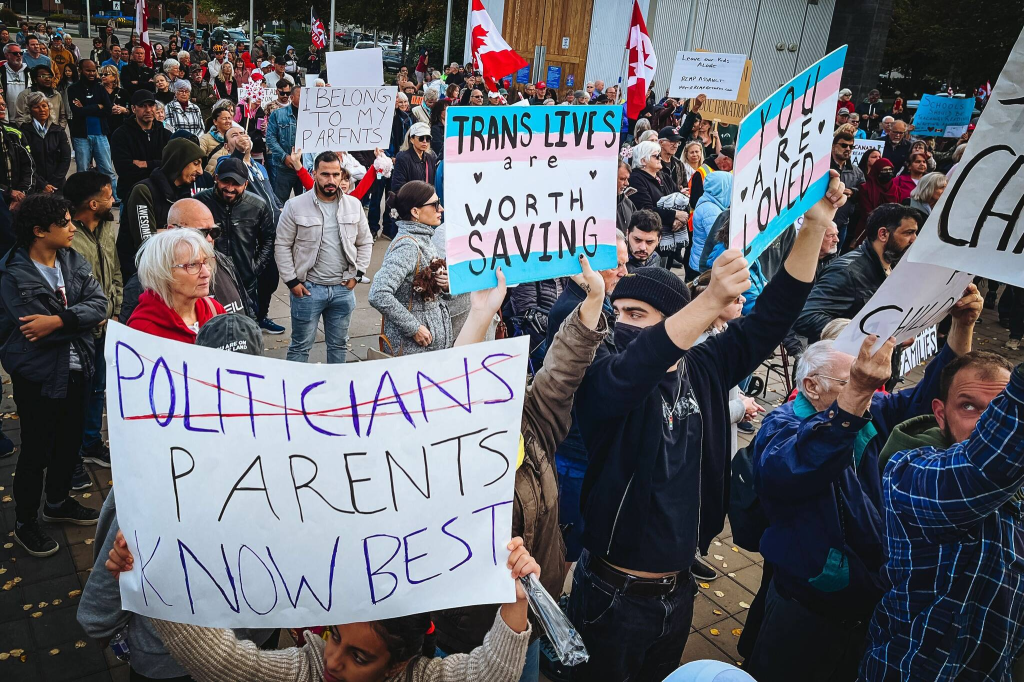
In cities across Canada on September 20 of this year, crowds participated in gatherings billed as a 1 Million March 4 Children, in the name of opposing what organizers termed “LGBT indoctrination” in the country’s schools. The numbers were considerably less than one million people, and local demonstrations drew counter-protests by LGBTQ activists; there were some verbal clashes between the two groups and a few arrests, but the marches passed more or less peacefully. It was interesting to observe, however, the way the 1 Million March was described by politicians and by the media, and what the descriptions may portend for the future of this and other social divides.
Criticism of the event was certainly strong, and came from some of the nation’s highest offices. “Transphobia, homophobia, and biphobia have no place in this country,” Prime Minister Justin Trudeau said in a tweet. “We strongly condemn this hate and its manifestations, and we stand united in support of 2SLGBTQI+ Canadians across the country – you are valid and you are valued.” The Official Opposition’s Jagmeet Singh echoed, “The rise of hate towards the 2SLGBTQI+ community is deeply alarming. All people deserve safety and freedom to be who they are. Today and every day, New Democrats [Singh’s party] stand with the trans community in solidarity.” Mayor Mark Sutcliffe of Ottawa, where the 1 Million March convened on Parliament Hill, likewise posted, “I condemn any form of discrimination or hatred. Members of the 2SLGBTQIA+ community have the right to live free from harassment and bigotry.” Prior to the scheduled rallies, the Canadian Anti-Hate Network characterized them as “supported by a big tent of far-right and conspiratorial groups, including Christian Nationalists, COVID-19 conspiracy theorists, sovereign citizens, and anti-public education activists.” And representatives of the LGBTQ community were direct in calling out the motivations of the march, typified in a statement by Kelowna Pride, based in the mid-sized British Columbian city: “We…recognize the harm that is often done to our communities by being drawn into and exposed to hateful rhetoric and situations…We firmly believe that the forces for love, justice, and equality outnumber those for hatred, fear, and division.”
On the other hand, press coverage of the 1 Million March didn’t cast the demonstrations in quite such dire terms. Most stories, such as the Calgary Herald’s, explained that they were protests “against sexual orientation and gender identity (SOGI) education, which promotes inclusivity and understanding of LGBTQ+ students in public schools,” while CTV News quoted marcher Jashandeep Dhillon in Regina Saskatchewan, who told a reporter, “I don’t want [my children] to be educated on whether they are a girl or a boy. Let them be what they want to be. If he decides in his life, when he’s an adult, if he wants to change, I’m okay with that.” Columnist Rosie DiManno in the reliably liberal Toronto Star noted how surveys indicated a large majority of parents believed they should be told if their school-age child identified as transgender: “This is not extremist and it is not reactionary…These aren’t fringe numbers and this isn’t a fringe demographic.”
Indeed, the day before the 1 Million March, newly released results of a Canadian poll confirmed that only 35 percent of respondents concurred with the proposition that “anyone who wishes can identify as a woman,” while 67 percent weren’t on board with gender-neutral language like “pregnant people,” and 60 percent expressed the sentiment that the national media give transgender issues “too much attention.” Further polling data from October showed that nearly half of those queried were in favor of invoking the “notwithstanding clause” – a legal loophole allowing provincial legislation that temporarily overrides provisions of the federal Charter of Rights and Freedoms – to notify parents that a child had changed pronouns at school, against 31 percent who opposed it. Whatever the figures imply, they don’t suggest a few stodgy holdouts resisting an overwhelming consensus.
As much as anything, both the numerical turnout of the 1 Million March and the background of those who joined in seemed to preclude the convenient stereotypes of haters and hicks. Though some based their opposition to classroom gender instruction on religious values, the religion invoked was not always Protestant or Catholic Christianity but Islam, whose Canadian adherents have in the past often been fairly depicted as victims of hate themselves (a mass shooting at a Quebec City mosque killed six people in 2017). “Everyone, regardless of faith or belief, is warmly invited to march alongside us in unity and friendship,” assured the 1 Million March website; the September 20 assembly was initiated by Kamel El-Cheikh, an Ottawa Muslim, and a range of hijab-dressed and non-white marchers were visible at the rallies. This is at odds with the usual portrayals of social conservatives as ignorant rural Bible-thumpers, and in an increasingly diverse nation with a welcoming immigration policy, opponents may have to negotiate a trickier rhetorical framework than they’ve been used to: if you accuse someone of homophobia, might you in turn be called Islamophobic?

From the broadest perspective, the state policies of introducing lessons in sexual and gender identity into school curricula, along with drag performances at public libraries and displays of Pride flags at public buildings, may simply represent the final overreach of a cause that’s otherwise been generally accepted. The recent poll numbers showed that a majority of those asked agreed that transgender people faced discrimination, and that overcoming it was a measure of progress. An intuitive or anecdotal sense of day-to-day interaction among families, friends, neighbors, colleagues, and strangers would seem to bear this out, insofar as individuals who happen to be gay or transgender can pretty much go about their business without stigma. To paraphrase the well-known slogan, they’re here, they’re queer, and we’ve all gotten used to it.
So since gay celebrities and gay marriage are no longer very controversial, in the absence of truly disenfranchised populations we are now inventing them, along with a corresponding class of -ists and -phobes who must be vilified for the disenfranchising. But these inventions are becoming less and less workable. A similar dynamic now obtains in many issues, in which distinguishing the downtrodden vulnerable from the dominant oppressors is no longer quite so easy. Racism, for instance, once meant segregated lunch counters, demeaning caricatures, and burning crosses; now it means insufficiently diverse TV awards shows. Fatigue – with the news stories, with the changing lexicons of sanctioned language, with the whole idea – is inevitable.
Thus the campaign for LGBTQ rights, like other social movements before it, has in some ways become a victim of its own success: once the institutional barriers to opportunity come down (through legislation), and once the public barriers to recognition dissolve (through sheer familiarity), proponents are left with the realization that legal equality isn’t the same as cultural parity, and that they remain a small minority about which the rest of society isn’t particularly interested. So one way to retain their moral righteousness is to redefine opportunity as mandated inclusion, and to redefine recognition as compulsory approval, such that popular hesitancy toward either is proof that “the struggle continues.” Another tactic may be to turn what was previously thought to be a one-time accommodation of one obscure, hitherto underground proclivity into a growth industry, whereby even the very young and inexperienced are encouraged to categorize themselves into identities formerly reserved for mature adults. In each case, any skepticism or resistance must also be recalibrated into abject, irrational hostility.
For politicians like Justin Trudeau or Jagmeet Singh, though, such an approach risks alienating swaths of the voters whose support they require. It’s one thing for full-time single-issue advocates to write off outsiders as stupid or malicious – they can make their case as loudly, or as insultingly, as they need in order to stir up their base. But sitting or aspiring legislators should be a lot more careful in throwing around words like “hate,” “harassment,” and “bigotry” to dismiss what may turn out to be a significant portion of the electorate, and whose feelings about general problems in the economy or the environment might make them perfectly receptive to political persuasion. Shame and condescension are poor arguments for anything, especially on behalf of a cohort as suspiciously specialized as one that seeks to instruct nine-year-olds in sexual orientation and gender identity. This is a dilemma that will probably confront many Canadian candidates in the near future, as it becomes increasingly plain that some matters are just too difficult to be split along a simple matrix of allies and enemies, enlightened and backward, tolerant and intolerant, and that there are just too many good people on the wrong side.
 George Case, Writer