
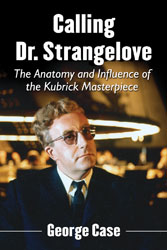
After authoring three published books on classic rock and contributing to others, I was eager to branch out into another area of popular culture, and I developed a proposal for a monograph on a classic film, Stanley Kubrick’s 1964 black comedy Dr. Strangelove, or: How I Learned to Stop Worrying and Love the Bomb. The project allowed me to explore weightier topics than the careers of twenty-four-year-old pop musicians and, once a contract with the specialty academic house McFarland was secured, prompted me to bring my research skills up to a more scholarly level as well. Calling Dr. Strangelove, released in 2014, has earned a modest but respectable place in the field of cinema studies, and has introduced me to a wide critical community devoted to the life and work of one of the most important filmmakers of all time.
As I had with Jimmy Page and Led Zeppelin, I focused my analysis of Dr. Strangelove on rescuing Stanley Kubrick from his admirers – “Sometimes,” I explained in the book’s introduction, “…the most respectful praise must avoid lapsing into overpraise, and an appreciation of merits must share space with a notice of flaws.” Thus I took time to compare the film to Kubrick’s earlier and later movies (he only made eleven commercial features in forty-odd years), and to delve in to the hard facts of nuclear deterrence and Cold War politics which Strangelove satirized. It helped that I was at the time employed in a college library, where I had free access to online databases of news articles and research journals, and to the library printer, as I compiled a thick binder of material on the more obscure details of Kubrick’s oeuvre, and that of his colleagues Peter Sellers, co-screenwriters Peter George and Terry Southern, cinematographer Gilbert Taylor, and some of the truly twisted source figures who inspired the story, including theorist Herman Kahn, hawkish US Air Force general Curtis LeMay, and LeMay’s successor as head of Strategic Air Command, General Thomas Power, who once stated, “I maintain that death is preferable to life under Communism.” For a few years, Power had the authority to launch the US nuclear arsenal on his own accord, if the idea had taken him. Jesus.
This increased depth of research was augmented by personal contacts I made with teachers and other film experts in Britain and North America, as well as with Canadian actor Glenn Beck, who played the navigator of the B-52 piloted by Slim Pickens’ Major Kong in Dr. Strangelove; Glenn’s recollections of shooting under Kubrick on the English set in 1963 brought an invaluable insight into the director’s temperament and methods. I also drew on my long interest in film (which predated my hardcore rock ‘n’ roll fandom) to discuss the legacy of Dr. Strangelove on later movies including Seven Days In May, The Russians Are Coming, the Russians Are Coming, M*A*S*H, War Games, and even Planet of the Apes. More contentiously, I appraised the 1964 film as Kubrick’s high point, in which he blended theme and narrative more effectively than in any of his other works, among them The Shining, A Clockwork Orange, and 2001: A Space Odyssey. Finally I argued that in the scathing ridicule of Dr. Strangelove, Kubrick “inadvertently created an overwhelming endorsement of the non-totalitarian adversary.” Dr. Strangelove was never shown in the USSR.
As a companion guide to a famous but often misunderstood picture, Calling Dr. Strangelove added to a growing collection of other books on Stanley Kubrick and his art: when I began writing there were no other titles devoted to this single movie, but although two others besides mine have since emerged, the one I produced has held its place in the critical literature (I also contributed an entry on Dr. Strangelove to a two-volume text from 2019, American Political Humor: Masters of Satire and Their Impact on US Policy and Culture). Unfortunately, what also continue to be relevant are Dr. Strangelove‘s indictments of how close the impulses of an insane politician or military leader – funny in fiction, horrifying in the news – may bring us to the destruction of the world. As I quoted Slim Pickens reflecting in 1964, “You never know when some nut is going to push a button and start the next war and that is what the film is about.”
Next week: Here’s To My Sweet Satan: How the Occult Haunted Music, Movies, and Pop Culture 1966-1980

