
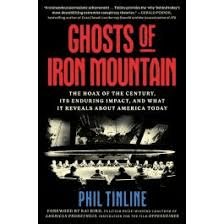
For me, the rewards of reading Phil Tinline’s Ghosts of Iron Mountain: The Hoax of the Century, Its Enduring Impact, and What It Reveals About America Today (2025) include its citation of my own Calling Dr. Strangelove in the bibliography and its quote from my contribution to the Encyclopedia of American Political Humor, but they certainly don’t end there. Tinline has written a comprehensive and highly readable history of the last sixty years’ worth of conspiracy culture, and of the curious little gem of a book that unintentionally became the common reference point for some of the wildest – and most damaging – conspiracy theories still floating around. Ghosts of Iron Mountain also goes some way to explaining just why conspiracy theories take hold as deeply as they do, and that some of them have at least a little grounding in reality.
First published in 1966, Report From Iron Mountain: On the Possibility and Desirability of Peace was a purportedly leaked think-tank paper prepared by the upper echelons of US political, military, and scientific establishment. Its chillingly clinical conclusion was the necessity of maintaining a national “war system” to ensure social and economic stability in the unexpected event of world peace – suggested substitutes for armed conflict included a permanent “war” on pollution, the costly pursuit of distant goals in space, promotion of blood sports and ritual sacrifice, and even a euphemized return to slavery. All the options were detailed and footnoted in the dry language of Cold War officialdom.
In fact, the Report was to government policy what This Is Spinal Tap was to rock music: a deader-than-deadpan parody of a real phenomenon that many in the audience assumed was a legitimate document. It was really written by journalist Leonard Lewin, with the encouragement of editor Victor Navasky and author E.L. Doctorow, drawing on the sober scholarship of earlier tracts like C. Wright Mills’ The Power Elite (1956) and the ominous projections of Dwight Eisenhower’s 1961 farewell address, which warned of a potential military-industrial complex overriding democratic rule, and the book was released with some of the merry-prankster spirit of the nascent American counterculture. That is, it was first presented as authentic, and not until later did the author and publisher confirm the satirical intent only a few critics originally picked up on. But by then it was too late.
Ever since Report From Iron Mountain came out, everyone from libertarians to anarchists have found its tone and its substance all too plausible. As Tinline notes, “The high walls of the post-1945 national security state had become a blank canvas onto which left and right alike could project all sorts of fearful imaginings.” After all, the US government had become a gargantuan organization that guarded explosive secrets; giant US aerospace and technology firms did wield immense power over the national agenda; high-level theorists like Herman Kahn (a model for the title character in 1964’s Dr. Strangelove) did prepare coldly detached studies about potential US options in nuclear wars and other nightmare scenarios. And most damning, a US president, possibly planning for peace, was killed in circumstances many Americans found to be incomprehensible absent some sinister agency operating behind the scenes. In a 1996 reissue of the book, Leonard Lewin wrote that he’d been trying to “caricature the bankruptcy of the think-tank mentality by pursuing its style of scientistic thinking to its logical ends.” The new edition was meant to forestall the circulation of bootlegged copies among far-right and paramilitary groups, who’d been touting it as a genuine text that confirmed their paranoid fantasies about the JFK assassination, secret concentration camps, and government control generally.
Because such fantasies have a basis of truth to them – politicians lie and cover up; governments plan for all kinds of distant contingencies; national economies are hugely complex – the Report‘s cult status across a political spectrum continues to this day. That none of its fictional proposals has ever been implemented in real life doesn’t matter: indeed, Tinline reminds us that by the 1970s the dysfunction of “the system” was a lot more apparent than its supposed omnipotence. However much it exaggerated the machinations of the military-industrial complex, though, the work was believable enough for some who read it to cross the line from reasonable skepticism about particular things to full-fledged conspiracism about everything. Contemporary alarms centered on the “Deep State” and the alleged inside revelations of QAnon descend from Report From Iron Mountain, and Ghosts of Iron Mountain is a valuable guide to sorting out the verified sources of such anxieties from the truly toxic delusions they’ve inspired.
 George Case, Writer