

Here’s a small tip: if you ever find yourself with an irresistible hankering to hear Lynyrd Skynyrd’s “Sweet Home Alabama,” AC/DC’s “You Shook Me All Night Long,” or Pink Floyd’s “Comfortably Numb,” but don’t have them in your music library, no problem: just tune in to your local Classic Rock radio station, and wait fifteen minutes. Problem solved, several times per day. But while “classic rock” is definitely a rigid business format defined by broadcasters, concert promoters, and other media professionals, it’s also an organic genre of music. Part industry standard and part legitimate art form, classic rock epitomizes the overlap of folk and commercial culture, an overlap that no longer obtains elsewhere in popular entertainment. So what exactly is it?
In North America, Classic Rock radio arose in the mid-1980s and evolved out of the earlier Album-Oriented Radio (AOR) category. Post-World War II economic prosperity and the populous Baby Boom had combined to make long-playing 33 1/3 RPM records the preferred medium of music’s youth market, coinciding with the increased admission of stereophonic sound systems and sonically sophisticated works like the Beatles’ Sgt. Pepper’s Lonely Hearts Club Band (1967). Rock ‘n’ roll albums were no longer mere collections of catchy two-minute songs, the catchiest released to compete for airplay on Top 40 outlets and lip-synched on primetime TV spots, but cohesive suites of style and theme spread across several pieces, some of them lasting five minutes or longer. Just as albums displaced 45 RPM singles as the favored product of young consumers, so AOR displaced Top 40 as the favored broadcast channel of young listeners, where they might expect to hear choice tracks or entire sides from a disc by “underground” acts like Iron Butterfly or Vanilla Fudge, or further-out artists like Sun Ra or Captain Beefheart – at least at first.
By the 1970s, however, AOR had jettisoned much of its original experimentalism to rely on a pre-vetted lineup of proven successes, and this is where the genre’s critical reputation began to decline. “Something happened to rock music in the 1970s that it has never quite recovered from: the music congealed into a dense, ponderous and soporific mass,” wrote the New York Times‘ Howard Hampton in 2001. “Rock, as FM radio defined, promoted and administered it, became less concerned with representing life than with merchandising ready-to-wear lifestyles, serving up self-mythologizing caricatures of lust, rebellion, sensitivity and anything else bands could get away with.” Classic Rock radio extended this orthodoxy into the next decades, by sanctifying the back catalogues of select performers and strictly excluding others, reinforcing a hierarchy of greatness in the circular reasoning identified in 1995’s Rolling Stone Encyclopedia of Rock & Roll: “Through AOR, FM radio became almost as, and some would argue substantially more, conservative than the AM radio of the Sixties to which FM had been an alternative…AOR music, which is now termed ‘classic rock,’ is played all the time because it’s popular: it remains popular because it’s played all the time.”
The criticisms are valid, and so is the additional charge that AOR might stand for “Apartheid-Oriented Radio,” for the inaudibility of Black acts on its airwaves (Jimi Hendrix occasionally slips past the programmers, and Bob Marley, Stevie Wonder, and Sly and the Family Stone if you’re lucky). At their most regimented, typical Classic Rock radio stations reduce the music to a nostalgia show, often kidded as “Jurassic Rock” or even “Comfort Rock.” But there are other ways to think of the form, beyond the definition enforced by advertisers and program consultants.
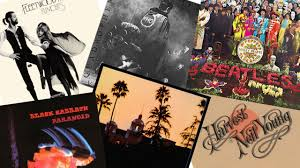
To start with, much of what was originally classed as Classic Rock really did belong to a lost era. By the 1980s many indisputable talents were no longer active in their best-known incarnations, either because they’d actually died (Hendrix, Marley, Janis Joplin, Marc Bolan), officially disbanded (Cream, the Eagles, the Band, Creedence Clearwater Revival), had fragmented and reformed with substitute or partial lineups (Fleetwood Mac, Pink Floyd, Black Sabbath, Kiss, the Kinks, Deep Purple), had lost an irreplaceable member (Keith Moon of the Who, Bon Scott of AC/DC, Ronnie Van Zant of Lynyrd Skynyrd, John Bonham of Led Zeppelin, Jim Morrison of the Doors), or had simply aged out of their creative heyday (Bob Dylan, Eric Clapton, the Rolling Stones, the Grateful Dead). Broken up since 1970, the Beatles were permanently relegated to the ages with John Lennon’s 1980 murder. Beyond the erratic or prematurely truncated career trajectories of the individual musicians, their music had nevertheless maintained a loyal following – as was also the case with Charlie Parker, Hank Williams, Robert Johnson, or for that matter Wolfgang Amadeus Mozart. Measured as art whose influence had outlived its artists, then, this era of rock had become classic indeed.
It was also significant that even the most skeptical historians of rock’s evolution conceded the landmark achievements of the classic epoch. Not only had the sheer volume of record and ticket sales transformed the industry from the 1960s onward, but the social changes associated with the music were incontestable. Classic Rock radio certainly made arbitrary distinctions of what fit into the canon (you’d hear “Helter Skelter” but not “She Loves You,” for instance, or “Lay Lady Lay” but not “Blowin’ In the Wind”), yet the overall sense of a singular cultural flourishing between about 1965 and 1975 was hard to refute; just as cineastes appraised the Golden Age of Hollywood in the 1930s and 40s or literati compared the writings of F. Scott Fitzgerald and Ernest Hemingway, so too could rock listeners assess the enduring legacies of the British Invasion, or Bob Dylan going electric, or Woodstock, or Altamont, or “Stairway to Heaven.” Much of the assessment became mythologized, corporatized, and commodified, of course. But that didn’t make it wrong.
And Classic Rock became enshrined only after numerous later offshoots of the music had sputtered out: punk, disco, and so on. Sure, plenty of songs from acts who’ll never be heard on Classic Rock radio hold up well, plenty of musicologists take the Sex Pistols more seriously than Aerosmith, and Prince likely has more admirers than Peter Frampton. But, coasting on years’ worth of momentum in the 1980s, the music business put a lot of product before the public without the authentic public demand that nurtured earlier acts. Record labels gambled big on minimalist, synthesizer-based New Wave performers, and packaged tabloid fodder like Madonna and Michael Jackson in the glossy new medium of music video, all of which made older guitar heroes and road warriors seem that much more substantial. Brad Tolinski of Guitar World magazine pointed out the differences in 1993:
So, what is it about the music of Steve Miller, Pink Floyd and Kansas that holds generation after generation in its thrall? MTV, with its shiny new icons, should’ve put an end to the cult of Classic Rock back in the Eighties. Oddly, however, music video may have helped perpetuate its popularity. Thanks to constant exposure on MTV, today’s pop heroes somehow seem smaller, more disposable than their predecessors. But pre-MTV bands like Queen, the original Kiss, and Led Zep have retained a powerful mystique. Unlike today’s overexposed supergroups, those Classic bands were rarely captured on film, and when they were, they left distant, grainy images which have themselves taken on an almost mythic power. Ultimately, I suspect the real reason that Classic Rock music still thrives is that the bands of the Seventies worked a little harder on their arrangements and experimented with greater discipline than their counterparts of today.
That interregnum of Culture Club, Wham!, Duran Duran, the Eurythmics, Huey Lewis, Cyndi Lauper, Quiet Riot and the Go-Gos indirectly led to the codification of Classic Rock: there was a crucial phase when Steve Miller, Pink Floyd, Kansas, Queen, Kiss, and Led Zeppelin were written off as dinosaurs next to the telegenic hotness of the younger stars. But once the hype faded, the scandals died down, and audiences tired of the videos, it wasn’t the dinosaurs who’d gone extinct. Instead they’d survived as the legends and demigods which FM radio would soon be adulating around the clock. The advent of Compact Discs, too, revived the shelf lives of many analog records from the 1960s and 70s. On one hand, this was a convenient way for music conglomerates to retail old wine in new technological bottles, but on the other, millions of listeners were genuinely pleased to appreciate rich aural textures crafted into Dark Side of the Moon, Abbey Road, Born To Run, and other fifteen- or twenty-year-old albums.
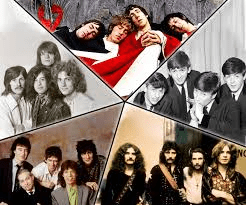
I can’t say I was an original fan of Classic Rock. I was born the month Sgt. Pepper was released, in fact on the very day the Jimi Hendrix Experience made its incendiary American debut at the Monterey Pop Festival, so by the time I was old enough to develop a sense of musical taste, the music I was drawn to was already dated. Not all of it: in my early teens I owned and liked records by U2 and the Police, and the first 45 I ever bought was Van Halen’s 1982 cover of Roy Orbison’s “Pretty Woman.” But I often explain that the reason I got so deeply into the music of the 1960s and 70s was because I grew up in the 1980s. If you’d spent your early adolescence constantly subjected to “We Are the World,” Olivia Newton-John’s “Physical,” Lionel Richie’s “Hello,” and REO Speedwagon’s “Keep On Loving You,” then hearing “All Along the Watchtower” and Sticky Fingers would have been epiphanies for you too.
There was no AOR or Classic Rock radio station in my small city, either. On the local Top 40 broadcaster I enjoyed the weekly syndicated show “Soundtrack of Sixties,” which replayed great Motown and AM pop hits from the decade, but otherwise the heavier, album-based music that’s since turned into a Baby Boom cliché was still, for sixteen-year-old Gen Xers in 1983, a source of mystery and awe. I didn’t have Classic Rock foisted on me by some celebrity shock jock, programming what the sales office calculated would boost ad revenues; I discovered it with my friends, huddling worshipfully around tape decks in smoky apartments. Forty years later, I’m grateful for those first revelations, when Harvest, Electric Warrior, and Master of Reality were old, and the world was young.
These days I’ll sometimes tune in to one of several Classic Rock stations in my area when I’m driving, and maybe I’ll even hear something not overplayed into oblivion, but that’s not my ideal way to appreciate the music. My ideal was already realized decades ago. The other messages blaring at me from screens and speakers then – and which haven’t stopped blaring at all of us ever since – insisted that I be hip or miss out, that keeping up with the latest mediated thing is all-important. Luckily, Classic Rock was there, telling me to let it be, to take it easy, that the song remains the same, and that everything is dust in the wind. No matter what we get out of this, I know: I know I’ll never forget.
 George Case, Writer