
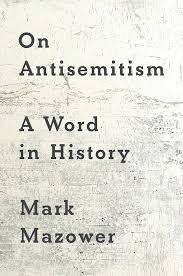
There are books about single enduring ideas, books about single important years, and books about single influential movies or songs, but there aren’t many books about single familiar yet contentious words. Mark Mazower’s On Antisemitism: A Word In History falls into the last category. It’s not a chronicle of how Jewish people have been persecuted through the centuries, and nor is it a study of modern Jewish culture and politics, although it incorporates useful summaries of those in tackling its chief subject. Mazower’s achievement here, instead, is to analyze our various understandings of the term Antisemitism as it’s been invoked over the last couple of hundred years – and to demonstrate how much those understandings have varied, and why. It’s a fascinating and timely project.
Christian animosity towards Jews dates back at least to medieval Europe, and was occasionally expressed through murderous violence. But it was not until the nationalist movements of the 1800s that some Europeans began to positively declare themselves anti-Semites, in reaction to the alien group they perceived among otherwise homogenous populations within defined borders. Mazower shows how this trend was, ironically, aggravated by enlightened policies towards Jews themselves, as they were gradually granted more social acceptance within particular countries and became associated with the changes wrought by capitalism and urbanization. It was easy to blame Jews for problems which affected everyone, since Jewish individuals participating in the new forces of finance, mass media, and revolution remained conspicuously different; anti-Semitism, whether abstract argument or tangible malice, was in that sense an inverted form of nationalism.
By the Twentieth Century, of course, anti-Semitism was more readily recognized in the official and unofficial policies towards Jewish immigrants in North America, in the form of admissions quotas in universities, “restricted” hotels and other establishments, and persistent popular hostility derived from both ancient hatreds and new conspiracy theories – and, at its very worst, in Nazi Germany. After World War II, when the extent of catastrophe Hitler wrought upon the Jews of Europe gradually became known, the image of what constituted anti-Semitism, and the moral taint that went with it, appeared indelible.
But then two things happened. One was the establishment of the state of Israel in 1948, and the other was the gradual decline of “traditional” anti-Semitism in the following decades. On Antisemitism breaks down the complex debates between Israeli and diaspora Jews over what the new nation represented to them – long-sought ancestral homeland for all, or dubious experiment relevant only to some? – as well as Israel’s emergent program to become front and centre in Jewish identity everywhere. Successful and secure American or Canadian Jews were reminded of Israel’s vulnerability to Arab enemies, and calculated messaging transposed the notion of anti-Semitism from past pogroms to current Mideast conflicts. “The sense of collective victimhood that has beset contemporary Israel’s understanding of itself and its place in the world is a stunning reversal of what Zionism’s founding fathers expected or desired,” Mazower writes. As a consequence, anti-Semitism was, over time, defined primarily as any opposition to policies of Israeli governments, to a point where denunciation of a foreign country might be considered a domestic hate crime in the US, Canada, or elsewhere. As Mazower puts it, by 2004, “The anti-antisemitism campaign was creating not only a bureaucracy but a diplomacy all its own.”
On Antisemitism is a direct response to the charges leveled against the global reactions to the Hamas attack on Israel in October 2023, and Israel’s overwhelming retaliation in Gaza in the months that followed. A word once used to characterize bigotry, exclusion, and German death squads has been somehow made applicable to newspaper editorials, student demonstrations, and the United Nations General Assembly, a misappropriation which Mazower calls out with sensitivity and care. The book comes too early, though, to address the ugly rhetoric coming from today’s alt-right, as online trolls and provocateurs make jokes about gas chambers and lament Israel’s supposed nefarious influence on US foreign policy, all in the name of Making America Great Again. That sounds like a reversion to the anti-Semitism of an older era, but, as this important work explains, a clear picture of exactly what anti-Semitism is and isn’t, which everyone can agree on, may already be beyond us.
Completely unrelated point: On Antisemitism references a Jewish historian previously unknown to me, by the name of Amos Funkenstein. Sounds like an awesome blaxploitation flick, or an album by George Clinton.
 George Case, Writer