

This year marks the 25th anniversary of the Monica Lewinsky scandal that consumed the second term of Bill Clinton’s US presidency. While Clinton’s brief affair with the twenty-four-year-old White House intern ended in 1997, it came to light in early 1998 and was the dominant news story of the next several months, from the earliest January revelations of the relationship through the new medium of the internet (the Drudge Report), to the September release to Congress of discoveries from the ongoing investigation into Clinton’s business and personal dealings (the Starr Report), and culminating in Clinton’s impeachment by December. Though America and the world have been occupied with far weightier issues in the decades since, the legacy of the Clinton-Lewinsky debacle lives on, in ways both inevitable and unforeseen.
The media itself has been most obviously affected by the episode. Prior to 1998 there had been a fairly solid division between the “respectable” and “tabloid” press, with the former maintaining a certain decorum in what it deemed newsworthy. Insiders might be aware of the extramarital liaisons carried on by a political figure (John F. Kennedy, notoriously), but their knowledge was never vetted for publication. By Bill Clinton’s ascendancy, however, there was simply too much popular interest in gossip and innuendo – and too many places to find it outside of traditional platforms – for the stories to be spiked. Established papers and broadcasters were no longer just competing with each other for their audiences, but with online sensationalists who had no investment in the old standards of discretion or probity. Even when the evidence was thin and the import dubious, this was a topic that otherwise reputable outlets couldn’t afford to ignore. As Neal Gabler wrote in 1998’s Life the Movie: How Entertainment Conquered Reality, “The news journalists themselves obviously couldn’t admit this. They spent the first weeks of the Lewinsky story desperately trying to justify their coverage of it by insisting that it was a matter of grave national concern. But the public knew better.”
Twenty-four-hour cable news programming had already risen in visibility with the OJ Simpson trial of 1995 and the death of Princess Diana in 1997, but the national soap opera of Bill and Monica gave the networks an even greater boost. Combining arcane analyses of political and legal maneuvers (subpoenas, depositions, grand juries, and poll numbers) with salacious details of tawdry sexual encounters (thongs, cigars, and Lewinsky’s stained blue dress), the unfolding narrative completed the transformation of journalism into merely another branch of entertainment: observers joked that CNN’s promotional slogan could well have been “All Monica, All the Time.” Even as subsequent events like 9/11, the Iraq War, the 2008 financial meltdown and the global pandemic of 2020-2022 were immensely more substantial than an adulterous president, they have been depicted for us in the same way – a steady churn of debate and speculation, dispensed less by responsible officials with some authority to make decisions than by pundits, party hacks, and professional spectators, daily and nightly weighing in on the “optics” of developments over which none of them have any formal influence. The Clinton-Lewinsky saga was the least of these electronic circuses, but it was the first.
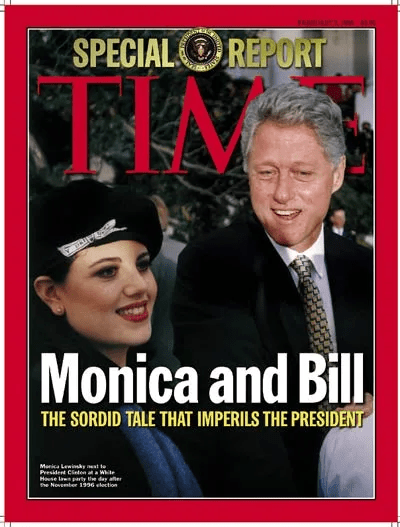
A second consequence of the 1998 spectacle has been the politicization of personal behavior. In democracies, of course, officeholders should be held accountable for their actions, and from Boris Johnson’s partygate to the unexampled criminal indictments of Donald Trump, no one should be above the law. Yet it was Bill Clinton’s dalliance with Monica Lewinsky that expanded the range of accountable actions that politicians could be judged on. The affair was certainly a private failing and hardly a crime, but it was conducted in the most public of settings – the Oval Office in the White House – and it was gradually exposed in a byzantine trail of inquiry into serious allegations of sexual harassment and real estate fraud. Clinton’s legal jeopardy derived not from the relationship with Lewinsky itself but from charges that he had perjured himself while testifying about it (“It depends on what the meaning of the word ‘is’ is,” he hedged under oath) and sought to obstruct justice by attempting to cover it up entirely. For his enemies, what Clinton did was too egregious not to prosecute; for his supporters, it was too trivial not to excuse. Impeached in the Republican-led House of Representatives on December 19, 1998, Clinton was acquitted by in the Senate on February 12, 1999. Ever after, political scandals in America and elsewhere have broken down along party lines. “All around [Washington DC],” concluded Time magazine at the year’s end, “there was a feeling that brutal, lasting damage had been done to an already threadbare culture of political accommodation, that it would not be the end of something but the beginning.”
Since 1998, single legislators have taken preliminary steps toward impeachment against Presidents George W. Bush (for various “high crimes and misdemeanors,” including war crimes) and Barack Obama (for authorizing military action against Libya without Congressional approval), while Donald Trump was formally impeached by the US House of Representatives in 2019 (for abuse of power in pressing the President of Ukraine for political dirt against Joe Biden) and again in 2021 (for inciting an insurrection after his electoral loss to Biden). Now Biden himself is under threat of impeachment, over purported financial corruption tied to his son Hunter. Bill Clinton’s misdeeds may have been the most minor of any of these – “When Clinton lied, no one died,” blared placards against Bush 43 – but they gave critics ammunition enough to attack him for the remainder of his administration. However credible any impeachment motions against the White House occupants who followed him have been, they all originate from the Clinton prototype, whereby the Chief Executive is constantly scrutinized for glaring or obscure infractions his opponents can use to remove him from the job. Political battles rage less over broad policies than they do over individual offenses. Ironically, former Clinton prosecutor Kenneth Starr was hired by Donald Trump’s legal defense when Trump faced his first impeachment inquiry. “We are living in what I think can aptly be described as ‘the age of impeachment,'” he told the US Congress in 2019. Trump’s own history left him more liable to censure than any president before him, but he represented the inexorable outcome of a precedent that Starr, and Clinton, had established.
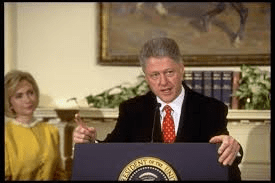
To many, Bill Clinton’s wife Hillary was the real casualty of the Lewinsky imbroglio – just as to others, she was the real villain. In January 1998 she called the whispers of presidential cheating no more than “a vast right-wing conspiracy that has been conspiring against my husband,” a dismissal that soon came back to haunt her. No doubt there was by then a concerted effort by US conservatives to denounce and block any element of the Democrats’ agenda – Republican Congressman Newt Gingrich had introduced an aggressive style of attention-grabbing partisanship – but as more evidence of the affair emerged, her assertion turned into an unintentional punchline (in August Bill Clinton finally admitted that he’d had “inappropriate intimate contact” with Lewinsky). Hillary Clinton’s “vast right-wing conspiracy” was echoed by her 2016 declaration that Donald Trump’s constituency was “a basket of deplorables,” another sweeping statement that was soon embraced by the very people she sought to condemn. Conspiring right-wing deplorables 2, Hillary 0.
With ordinary couples, most partners would have long walked away from a spouse as serially unfaithful as hers, but then most spouses are not the President of the United States. Over Hillary Clinton’s own career as Senator, Secretary of State, and two-time presidential candidate, a suspicion hovered that she had not stayed by her husband out of wifely loyalty but sheer opportunism, benefiting from his connections and name while she carefully plotted her own advance to the nation’s highest office. Though both Bill and Hillary rose from average backgrounds through education, hard work, and ambition, the meritocracy they extolled and seemed to personify in the 1990s has lately been discredited: what were once touted as the just rewards of talent and intelligence now look like the privileges of a rarefied elite, and what was once touted as earned success now looks like the relentless pursuit of achievement for its own sake, in which basic values of trust, humility, and marital fidelity are obsolete encumbrances. “Marriage…retains a distinctive ideological power for meritocrats,” argued Daniel Markovits in 2019’s The Meritocracy Trap. “Elites may reject traditional morality and affirm sexual freedom as matters of abstract political principle. But they live distinctively chastely, as nonpracticing libertines.”
The strangest long-term consequence of Bill Clinton’s trysts with Monica Lewinsky may be the enduring panics over sexual abuse and sexual depravity that now obsess communities of the angry and the paranoid. “Pizzagate,” the claim that Hillary Clinton operated a Satanic pedophile operation in the cellar of a Washington DC pizza parlor, was widely shared on social media in 2016 and led to the arrest of a heavily armed man in a DC family restaurant, where he planned to rescue to the helpless children supposedly trapped in the establishment’s basement (it didn’t have one). Crazy conspiracy theory, right? Except Hillary Clinton’s husband really did have illicit encounters with a woman young enough to be his daughter, and after his presidency Hillary Clinton’s husband really did keep occasional company with the mysteriously wealthy Jeffrey Epstein, who was later charged with the sex trafficking of underage females on his private estate. Throw in the docket of criminal cases against Canadian fashion mogul Peter Nygard, singer R. Kelly, the NXVIM organization, and numerous parishes of the Catholic Church, all over sexual exploitation of minors by the moneyed and the secretive, and the Clinton-Lewinsky affair descends from titillating sleaze into something more sinister.
Monica Lewinsky never said her sex with Bill Clinton was anything but consensual – indeed, she was an independent adult who initiated the flirtation – but she eventually admitted in retrospect that the differences in their age and status look more complicated than they did in 1998, noting how “inappropriate abuse of authority, station, and privilege” characterized her association with the President. As his political adversaries prepared their impeachment proceedings against him, Clinton’s public approval ratings actually increased, leading commentators to conclude that repressed, sex-fixated Republicans had badly misread the American’s people’s tolerance for personal indiscretions. Perhaps. Yet in 2023 there are still lingering beliefs that, behind closed doors, VIPs from Hollywood or business or government are indulging in fantastic debaucheries that no average citizen can imagine, let alone countenance. And what sounds more fantastic than the most powerful man in the world being pleasured at his desk by an attractive, submissive staffer? Twisted sex cults and clandestine networks of rich, devil-worshipping child molesters may be the sick delusions of gullible QAnon subscribers, but they haven’t been conjured out of thin air. They elaborate on seamy confessions and sworn testimony the whole world got to hear. From scurrilous rumor and dirty joke to manufactured outrage and lurid sideshow, and then a quaint memory from a safer and better time, we can now take a longer view of 1998’s top story. Twenty-five years on, the sad, sordid tale of Bill Clinton and Monica Lewinsky remains all too relevant, in our media, our politics, and in our darkest imaginings.
 George Case, Writer