
Any list of literature’s greatest war novels will probably include some familiar titles: Steven Crane’s The Red Badge of Courage, Erich Maria Remarque’s All Quiet On the Western Front, and Norman Mailer’s The Naked and the Dead, say, along with Vasily Grossman’s Life and Fate, and maybe Ernest Hemingway’s A Farewell to Arms. But all of those focus on the experiences of the foot soldier. The smaller subcategory of war novels about flying men doing battle in military aircraft may list less renowned works, but the best of these will hold up well against any fiction set on the ground – and the books may also provide more insight into what war has actually become in the last hundred-odd years.
Certainly Joseph Heller’s 1961 classic Catch-22, about an American B-25 medium bomber squadron in the Mediterranean Theatre of World War II, ranks among the most popular and influential war novels of all time – indeed, it’s among most popular and influential novels period. Heller himself had been an air force bombardier, and, interspersed with the book’s more famous set pieces of black comedy, his vignettes of planes under fire with scared and dying crewmen inside them were knowledgeable accounts of the visceral trauma experienced in aerial combat. Len Deighton’s Bomber, from 1970, is less celebrated (and was never adapted for film) but offers a powerful, at times almost clinical hour-by-hour depiction of one night in Britain’s strategic bombing campaign against Nazi Germany, pitting aircraft against aircraft as their human crews and human targets are demoralized, dismembered, burned, atomized and otherwise destroyed under the ordnance of Royal Air Force Avro Lancasters and Luftwaffe Junkers 88s. And ex-fighter pilot James Salter’s Hemingwayesque The Hunters, published in 1956, portrayed the subsonic dogfights of US F-86 Sabres and Soviet-built MiGs over Korea as existential tests of identity and manhood.
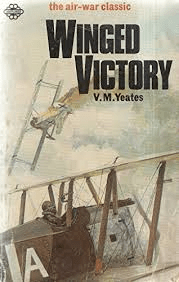
Predating these fine novels, and in some ways surpassing them, is Victor Maslin Yeates’ Winged Victory, from 1934. Yeates had flown Sopwith Camels for the Royal Flying Corps in the last months of World War I, and his episodic, semi-autobiographical narrative of cold dawn patrols in search of Fokkers and Albatri over no-man’s-land feels far more authentic – and deeply felt – than the many melodramatic stories and movies which have drawn on the same material. His characters are not dashing air aces but a believable cast of British and Commonwealth fliers ranging from instinctive killers and innocent idealists to ordinary pilots increasingly dubious of the conflict’s purpose – disconcertingly, even to the point of griping how “The successful people had got hold of the war, generals, politicians, usurers, industrialists, and a crowd of lesser parasites raking in the shekels…” Some of Yeates’ other passages, describing the sensation of open-cockpit flight when flight was young, are as poetic as anything by Wilfred Owen or Robert Graves:
The sun had put on robes of glory; all the air was full of his splendour, and the vast clouds were his galleons of state. Amid this mighty fleet the aeroplanes soared and darted and dived like falcons among Andean slopes and precipices, as fell and significant in their minuteness as the magnificent clouds were unmeaning in their huge pomp. For an hour they hawked and hunted up and down the empty cloud-walled corridors. They climbed high into the cold vacancy above the top-gallants of the shining argosies. Strips and scalenes of the far-down earth, its bitter pallor filtered out by the gauze of air, showed dim and blue between the faintly misted edges of the clouds, which, cut sharp against the sky, yet showed a trace of unmarmoreal nature at their bases.
Common to Winged Victory, The Hunters, Bomber, and Catch-22 is their setting of industrialized Twentieth-Century war. The air campaigns over northern and southern Europe and the Far East were conducted as a kind of shift work, with aircrews stationed in relative comfort and safety behind the front lines when they were not flying off in advanced equipment to kill each other miles above the earth; central to each novel is how the sheer terror of the protagonists’ specialized duties contrasts against the social dynamics and private reflections afforded by their security back at Pianosa, Warley Fen, Kimpo, or the outskirts of a French village. Battle by then had become a mass mobilization of technology and labor, more dangerous but scarcely more dehumanizing than the peacetime routines of the warring societies. You don’t have to be cowering from flak in the nose of a B-25 to grasp the fundamental absurdity of the modern condition – Catch-22 only makes the absurdity explicit. “Sometimes I think it’s just the machines of Germany fighting the machines of Britain,” says an RAF pilot in Bomber. And Winged Victory reminds us that the civilizational advance represented by aviation’s development was negated by aviation’s propelling civilization back to barbarism:
For the first time in the recorded universe this thing was possible; for the first time the power and the speed and the legerity and the liberty kissed in circumstance: for a year, perhaps, circumstance would hold, and there would survive a few hundred people who had flown with expert malice that menacing springheel of the air with licence to do what the devil they liked. And thousands would not survive; the licence was costly.
 George Case, Writer