
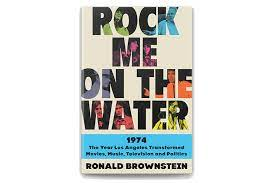
An odd subcategory of nonfiction publishing has sprung up in the last couple of decades: books about years. There’s Fire and Rain: The Beatles, Simon and Garfunkel, James Taylor, CSNY, and the Lost Story of 1970 (2011), What You Want Is in the Limo: On the Road with Led Zeppelin, Alice Cooper, and the Who in 1973, the Year the Sixties Died and the Modern Rock Star Was Born (2013), Never a Dull Moment: 1971: The Year That Rock Exploded (2016) and 1968: The Year That Rocked the World (2004). A related trend consists of monographs that explore the legacy of single genres within select periods, including Pictures at a Revolution: Five Movies and the Birth of New Hollywood (2008), Season of the Witch: How the Occult Saved Rock and Roll (2014), Hotel California: The True-Life Adventures of Crosby, Stills, Nash, Young, Mitchell, Taylor, Browne, Rondstadt, Geffen, the Eagles, and Their Many Friends (2006), and They Just Seem a Little Weird: How Kiss, Cheap Trick, Aerosmith and Starz Remade Rock and Roll (2020). The latest addition to this long-titled field is Ronald Brownstein’s Rock Me On the Water: 1974: The Year Los Angeles Transformed Movies, Music, Television, and Politics (2021).
Rock Me On the Water argues that 1974 represented the final triumph of 1960s philosophies in mass consciousness. Successful studio movies Chinatown and Shampoo commented on official corruption and sexual liberation; hit TV series All In the Family, M*A*S*H, and The Mary Tyler Moore Show brought the contemporary issues of racial politics, militarism, and women’s independence into millions of living rooms; and popular musical performers like Linda Ronstadt, Jackson Browne, and the Eagles communicated the hippie ideals of personal freedom and growth to a vast young audience. All of these emerged from California as the Watergate scandal confirmed the coverups and cynicism that protesters had long detected in the Establishment, and as the Golden State itself was electing a new governor, the unconventional and oddly spiritual Jerry Brown.
Brownstein effectively ties all these narratives together, along with accounts of former student radical Tom Hayden’s marriage to Hollywood rebel Jane Fonda, and the career of producer Bert Schneider, the man behind both the TV contrivance of The Monkees and the Oscar-winning 1974 Vietnam documentary Hearts and Minds. The author also gets in some occasional big-picture insights: “It wasn’t too much of a stretch to say that Jerry Brown in 1974 embodied both the best of the Baby Boom (its intelligence, creativity, and determination to rethink old assumptions) and the worst (self-absorption, a tendency to value theory over experience an aversion to discipline and focus),” he writes, and elsewhere concludes, “As the Baby Boomers deepened their hold on Hollywood, the movies, like television and music, both cemented the new social consensus and tamed its most threatening aspects.”
The problem with Rock Me On the Water, though, is that like other cultural histories it’s far too selective in illustrating its thesis. Brownstein seems to have built his reporting around interviews with key players like Chinatown and Shampoo screenwriter Robert Towne, All In the Family producer Norman Lear, and big celebrities like Jackson Browne, Linda Ronstadt, and Warren Beatty, suggesting that such exclusive, on-the-record access dictated the book’s message as much as any more detached reflections. And much of the cultural evolution he perceives actually occurs in the years on either side of 1974, making his title subject, no less than his premise itself, seem rather arbitrary, chosen for its gimmicky appeal over any historical accuracy.
Books like Rock Me On the Water also risk reading far too much into show business products that are essentially made to be promoted. Charting the influence of classic entertainment can be seductively easy; charting the influence of a scientific community, a religious movement, or a criminal underworld puts other researchers at a disadvantage, insofar as those organizations don’t have publicity agents and their achievements aren’t manifested in famous movies, sitcoms, or albums. Popular culture is a legitimate phenomenon by which to measure social change, certainly, but we shouldn’t exaggerate how precise the measurement can be. It’s enjoyable and convenient to study – and you might get to meet Linda Ronstadt and Warren Beatty while doing so – yet other fields may offer better, if drier, explanations of how we’ve got to where we are. And many cultural histories fall into the cliché of introducing Big Reveals that any reader can see coming a mile off, as when Brownstein describes how the young Californian director George Lucas in 1974 began to envision “a space epic inspired by the Saturday morning movie serials of his youth…called Star Wars.” Star what? Never heard of it.
I say all this, admittedly, as someone who’s contributed my own modest entries to the catalogue of books that includes Rock Me On the Water. My 2010 title Out Of Our Heads: Rock ‘n’ Roll Before the Drugs Wore Off used the Beatles, Bob Dylan, and later artists to index the rise and fall of the drug culture; Here’s To My Sweet Satan: How the Occult Haunted Music, Movies, and Pop Culture, 1966-1980, from 2016, interpreted blockbusters like Rosemary’s Baby, The Exorcist, and The Omen as symbols of a widespread mania for horror and the paranormal; in 2021 my Takin’ Care of Business: A History of Working People’s Rock ‘n’ Roll asserted that the likes of Lynyrd Skynyrd, AC/DC, and Bruce Springsteen were heralds of today’s right-wing populism. But I put crucial disclaimers in those volumes: “A critical mass of production and promotion means that there is less and less to distinguish where advertising begins and the advertised artifact or activity ends. Junk becomes inflated into treasure almost immediately, and then decays back into junk all the sooner.” (Out Of Our Heads) “It can be very easy, and very wrong, to scan the theater marquees and Top 40 charts of a given epoch and extract a single defining theme. A scattering of vaguely related famous names and titles does not a groundswell make.” (Here’s To My Sweet Satan) “You can choose a few key names from within any few years of show business history to illustrate just about any wider tide outside it, if you’re sure to overlook the contradictions and qualifications that point the other way.” (Takin’ Care of Business) I think those are important caveats that writers of cultural history, and readers of Rock Me On the Water, do well to remember.
 George Case, Writer