
In November 1975 I was eight years old, growing up in my home town of Sault Ste. Marie, Canada. There was a huge storm one night that month, and I recall an elder calling me in from my yard in the evening, as small branches were beginning to blow off of trees. The next day at school the other kids in Grade 4 were discussing the storm: “It was a hurricane,” someone said. “No, it was hurricane-force,” corrected someone else, in the manner of boys. There’d also been a news story on the radio that morning, about a missing ship in the frigid waters of Lake Superior. Its route from the western shore of the lake to Toledo Ohio would take have taken it through our local Soo Locks, but the freighter was now lost somewhere in the inland sea just off the city limits. The ship, of course, was the Edmund Fitzgerald.
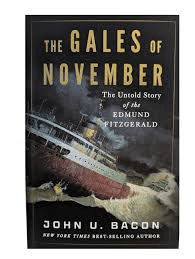
There are numerous books and documentaries about the Fitzgerald tragedy, in addition to Gordon Lightfoot’s timeless maritime ballad released just a few months after the vessel went down with all hands, but John U. Bacon’s 2025 book The Gales of November: The Untold Story of the Edmund Fitzgerald should now rank as the definitive account. Bacon has researched not just the shipwreck itself but the human stories of its twenty-nine-man crew, a haunting portrait of lifelong blue-collar sailing men (middle-aged Captain Ernest McSorley was on his last trip before retirement, earning extra money to pay his ailing wife’s hospital bills) working alongside young Now Generation dudes still searching for direction (deckhand Bruce Hudson left behind a pregnant girlfriend, and a bong). Just as significant, the author places the Fitzgerald and its casualties in the context of the post-World War II North American economic boom, when the Great Lakes were still at the centre of continental industry and the small towns and big cities of Ontario, Michigan, Wisconsin and Ohio were still vital stations on an international assembly line.
From this perspective, the Edmund Fitzgerald story is not just about a famous disaster – the number of victims, after all, was fewer than that of many passenger plane crashes – but about a lost society. Great Lakes ships served the Canadian and American foundries, carrying grain, iron ore and other raw materials from the rugged heartlands to metropolitan manufacturing hubs like Detroit, or down the St. Lawrence River and out to the Atlantic Ocean and the rest of the planet. This geography eventually became the Rust Belt and, later, a desolate swath of unemployment and addiction, but in 1975 it was the bustling core of western production and prosperity. The huge cargo carriers that crisscrossed Lakes Huron, Erie, Michigan and – most dangerously – Superior were essential to this order. As Gales of November reminds us, so were the men who operated them. “For three decades following World War II,” Bacon writes, “the Great Lakes hummed with all the power and prestige Silicon Valley enjoys today.”
Some of that prestige may have contributed to the loss of the Edumnd Fitzgerald herself. Competing to haul bigger loads faster and more often, captains and shipping companies exploited and circumvented contemporary regulations to fill their boats so much they sat precariously low in the water. On the night of November 10, 1975, the doomed Fitzgerald was subjected to a veritable storm of the century: weighed down with a nearly 30 000-ton load of taconite (iron ore pellets), huge, ocean-sized waves rolled over her and began to fill the hold. Captain McSorley, meanwhile – likely suffering the disorientation of sleeplessness and motion fatigue from a constantly heaving craft – steered the ship over the hazardous Six Fathom Shoal near Caribou Island in Canadian waters, where her bottom may have scraped the lakebed and ruptured an already stressed hull. The long, narrow design of lake freighters left them prone to violent twisting in heavy seas, and the Fitz may have ultimately come apart, “like bending a paper clip back and forth too many times before it finally snaps,” in Bacon’s words (the sunken ship was found in two separate pieces). It’s a harrowing image. I remember that the weather was bad enough, safely on land that night in November 1975 – thanks to Gales of November, I can understand how much worse it was for the twenty-nine men offshore, and how much their lives, work, and cold, fearful deaths meant for the region and the world.
 George Case, Writer