
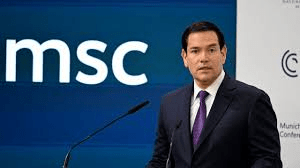
There was a revealing detail in US Secretary of State Marco Rubio’s speech before the Munich Security Conference on February 14. Widely interpreted as a conciliatory message to Europeans rattled by the America-First aggressions of the Trump administration, Rubio assured the attendees that the United States and Europe “are bound to one another by the deepest bonds that nations could share, forged by centuries of shared history, Christian faith, culture, heritage, language, ancestry, and the sacrifices our forefathers made together for the common civilization to which we have fallen heir.” And after gratefully acknowledging how Europe gave the world “the rule of law, the universities, and the scientific revolution,” the Secretary cited Europe’s cultural contributions: “It was this continent that produced the genius of Mozart and Beethoven, of Dante and Shakespeare, of Michelangelo and Da Vinci, of the Beatles and the Rolling Stones.”
As a classic rock enthusiast, I felt vindicated to hear that “A Hard Day’s Night” now ranks alongside Hamlet, and that Exile On Main Street holds its own against the Eroica Symphony; no doubt millions of fans will say they knew it all along. Yet I wonder if Rubio, or his speechwriter, considered the full implications of the pantheon he cited in Munich. Conservatives have long invoked a golden age of artistic expression that contrasts with the allegedly degraded junk product countenanced by liberal elites and their showbiz friends. The more strident among them – whose influence in the Republican party is growing – favor a race- or religion-based “post-liberalism” defined by pre-Enlightenment traditions, in which even the achievements of Renaissance painters or Romantic composers might seem suspiciously humanist. So how did the Beatles and the Stones sneak past the gate?
In 1964, as the Fab Four were reaching the top of the charts everywhere, critic Paul Johnson’s infamous New Statesman essay “The Menace of Beatlism” denounced the quartet as “a mass-produced mental opiate…an apotheosis of inanity,” while comparing exploited Beatlemaniacs with his own refined youth: “At 16, I and my friends heard our first performance of Beethoven’s Ninth Symphony. I can remember the excitement even today. We would not have wasted thirty seconds of our precious time on the Beatles and their ilk.” And in 1987’s The Closing of the American Mind, something of an Ur-text for the modern conservative movement, Allan Bloom lamented Rolling Stone Mick Jagger’s influence on impressionable collegians: “A shrewd, middle-class boy, he played the possessed lower-class demon and teen-aged satyr up until he was forty…In his act he was male and female, heterosexual and homosexual…He was beyond the law, moral and political, and thumbed his nose at it.” Yet in 2026, a cabinet member of the US president who promises to Make America Great Again lists Jagger’s band and the Beatles as emblems of the great civilization from which America originates.
The point is not that the rock ‘n’ rollers get the last laugh on the old fuddies, or that Marco Rubio’s survey of the western canon might earn him a generous B in a first-year humanities class, but that Rubio has accidentally exposed the contradiction at the core of the Trumpian mindset. In time, it seems, things once reviled as disposable or dangerous can be enshrined within a grand historical legacy – by the same people who angrily revile whatever happens to be outside of that legacy today. Donald Trump and his constituency idealize a patriotic national past, and conservatism’s intellectual exponents bemoan the decadence of modern culture, but they urge allies to their side by summoning figures who were not so long ago themselves considered cultural decadents and international subversives, leading generations astray with anthems of peace, love, lust, Satisfaction and Revolution.
Of course, libraries, museums, and concert programs overflow with works sanctified now but which were originally considered ephemeral or radical. Marco Rubio might have flattered the Eurocrats with his appreciation for Pablo Picasso, James Joyce, Frederico Fellini, or Georges Bizet, and betrayed the same double standard: “But only if we are unapologetic in our heritage and proud of this common inheritance” (never mind that my compatriots would have excoriated most of it at the time) “can we together begin the work of envisioning and shaping our economic and our political future.” At least he didn’t mention European luminaries like Vlad the Impaler and the Marquis de Sade. But by making his case with the Beatles and the Rolling Stones, whose world-changing music is conspicuously rooted in African American idioms and whose indelible fame still signifies innovation, community, and transcendence, Rubio showed how hollow is the nostalgic nativism he touted in Munich. American conservatives talk a lot about the glories of yesteryear, but when it serves them, they extol the glories of “Yesterday.” MAGA types preach allegiance to God and country, but in practice, it seems, they’re all about sympathy for the devil.
 George Case, Writer