
As early as his 1940 essay “The Lion and the Unicorn,” George Orwell shut down the original “what about” arguments with which progressives tried to shrug off the danger of a supposed geopolitical opponent, in this case Adolf Hitler: “The intellectuals who are so fond of balancing democracy against totalitarianism and ‘proving’ that one is as bad as the other are simply frivolous people who have never been shoved up against realities,” he wrote.
Decades later, variations on Orwell’s rebuttal were revived in the aftermath of September 11, 2001. “Islamic fundamentalists don’t object to the things campus leftists dislike about America,” chided an editorial in The Economist. “They object to the things that they like, such as freedom of speech, sexual equality and racial diversity.” In their 2004 book Occidentalism: The West in the Eyes of Its Enemies, Ian Buruma and Avishai Margalit reminded that “[t]o blame the barbarism of non-Western dictators or the suicidal savagery of religious revolutions on American imperialism, global capitalism, or Israeli expansionism is not only to miss the point; it is precisely an Orientalist form of condescension, as though only Westerners were adult enough to be morally responsible for what they do.” In other words, equivocate all you want, but sometimes the Bad Guys really are bad.
The same underlying message has been trotted out more recently, in defence of Israel’s military campaigns in Gaza and Lebanon since 2023, and the American-Israeli war on Iran in 2026. “Yes, This Is Your War, Too,” insists columnist Bret Stephens of the New York Times. Never mind the naysayers, this is really “A Mideast Moment of Hope,” according Barton Swaim of the Wall Street Journal. “The hard left has once again allied with Islamists,” sneers John Aziz in Quillette. Our enemies’ values are fundamentally alien to those of enlightened and comfortable westerners, runs the recurring theme; any protests over our attacks against them are misplaced at best and hypocritical at worst. Again, the claim is that today’s antiwar activists are simply frivolous people who have never been shoved up against realities.
Whatever validity this line of reasoning once had, it’s by now become pretty threadbare. Campus rallies in Canada or mass demonstrations in Europe may be comprised of naïve or thoughtless individuals, many of them young and idealistic, yet the standard assurances – that this or that superpower operation, aimed at this or that distant Third World regime, is only an unfortunate but necessary stand against tyranny – no longer convince. Why? Overuse, for a start. Successive generations have responded to some version of the anti-tyranny cause with flagging enthusiasm. Fighting Nazi Germany and Imperial Japan – sure; fighting the Soviet Union – well, okay; fighting global terrorism – um, I guess; fighting Islamic theocracy – really? What were formerly obvious choices between clear-cut moral and political ideologies are now more complicated. There may be Bad Guys, but there are no more good wars.
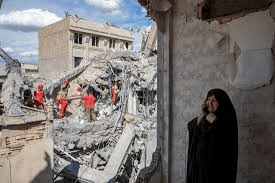
Part of the problem is that, in an integrated, globalized society, the targets of crusades in far-off lands increasingly resemble one’s neighbors, co-workers, and classmates (and may even be directly related to them). It’s harder to cheer foreign wars when our understanding of “foreigner” has been affected by travel, immigration, assimilation, and instant communications from the war zones. Meanwhile, it’s harder to deny the essential humanity of the people living under US and Israeli bombs in 2026 than it was to deny the humanity of their Japanese or Vietnamese equivalents of 1945 or 1970. The implacable Otherness of Communists or National Socialists decades ago has no modern parallel, notwithstanding the new populations our politicians and media outlets want us to demonize next. War has always been terrible, but the excuses for it weren’t always so easy to see through.
It’s also a lot more difficult to get behind wars for “democracy” when democracy itself seems to be crumbling from within. Across western nations, as well as in Israel and eastern Europe, the principles of liberalism – including rule of law, freedom of thought and expression, fair elections and orderly changes of government – are in an ongoing crisis. Some voices in the US and elsewhere even advocate for a “post-liberal” social order based on tribe or tradition, which hardly seems different from the ethnic and religious hatreds promoted by the mullahs and imams of the Arab world. The louder apologists strain to distinguish how free we are from how allegedly unfree is our latest adversary (so that whatever destruction we wreak upon them is entirely justified), the more suspicious they sound. Genuine democracy is undoubtedly not as bad as totalitarianism. Genuine democracy, however, may not be what we actually have.
Of course, if I had to pick either the relative openness of my country or the rigid polities of China, North Korea, Cuba, or revolutionary Iran, I know where my preference lies. But the case that anyone who doubts the righteousness of contemporary American and Israeli actions is merely a frivolous person, a useful idiot unwittingly enabling the oppressors of Beijing, Pyongyang, Havana, or Tehran, carries little weight today. Call us useful idiots, but millions of people do indeed have serious doubts about the righteousness of American and Israeli actions, after taking long looks at history, and at the oppressors currently based in Jerusalem and Washington DC.
 George Case, Writer