
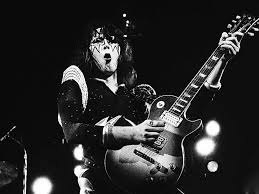
Nine years old in 1976, I was dead center in the target market for Kiss, the classic rock foursome whose original guitarist Ace Frehley passed away on October 16. At school, the other kids in Grade 5 were applying Kiss stick-on tattoos and Kiss makeup, showing off their Kiss comics, and starting their record collections with copies of Dressed to Kill and Rock and Roll Over. Even the shop teacher forbade us from decorating any woodworking or leathercraft projects with Kiss insignia. “They are self-proclaimed worshippers of the devil,” he warned. (Skeptical? Kiss = Knights In Satan’s Service.)
But I wasn’t enlisting in the Kiss Army. Already suspicious of fads and hype, I was dismayed when impressionable classmates announced that Kiss was now their favorite group (had they known any others?), grossed out by the garish fire-breathing and blood-spewing of Kiss’s stage shows, and indifferent to Kiss’s songs. Around the same time, an older pal took me to see the Sergeant Pepper’s Lonely Hearts Club Band movie, starring Peter Frampton and the Bee Gees, and I nearly left the theater in moral indignation after the Aerosmith performance. If the likes of Kiss and Aerosmith were rock ‘n’ roll, I thought, I don’t want any part of it. The swing music 8-tracks of Artie Shaw and Benny Goodman my parents played in the car – now that was good music.
As you may have guessed, I eventually came around. Today I’d rate Aerosmith’s coked-out “Come Together” cover of 1978 as one of the band’s artistic peaks, and I have a great appreciation for the infectious rock of the 1970s Kiss, which millions of listeners are now fondly remembering. Big hits like “Detroit Rock City,” “Strutter,” and “I Was Made For Loving You” have had heavy rotation on my personal playlists over many years, along with deeper cuts like “Black Diamond,” “Goin’ Blind,” “She,” “Rock Bottom,” “Come On and Love Me,” and “Strange Ways.” I once performed “Hard Luck Woman” at a book launch. If asked to choose a favorite member of Kiss when I was ten, I would have mustered a grudging choice of the Catman Peter Criss, reflecting my fondness for cats (every ensemble from the Beatles to the Banana Splits were comprised of different “personalities” for fans to identify with). But for a long time the real star of Kiss, for me, has been the late great Ace Frehley.
What made the difference? In my twenties, a good buddy of mine was a guitar player whose advanced technique I admired, and he turned out to have been a Kiss fan since childhood and a devout Frehley emulator. By this period Kiss, the functioning band, had taken off their makeup, changed membership a few times, and was no longer a teenybopper sensation but just another aging rock group whose best years were more and more obviously behind them. Peter Criss and Ace Frehley had been replaced; the hard-living Ace had earned a reputation as the authentic badass of what became a cynically commercial project. My friend and I even saw Criss play in a Quebec bar circa 1991 (“You guys have the best beer up here,” he enthused, taking a swig from behind his drums). So there was at first something slightly retro about getting into Kiss well after their cool quotient had declined, and I was probably not alone in my semi-ironic admiration for them. I found the music, though, had held up well: unassuming, almost generic hard rock but delivered with pomp and swagger, and Ace’s gritty, dramatic solos seemed to elevate the whole enterprise. Among a gang of hacks dressed as cartoon characters, he was the guy who passed for a rock ‘n’ roll virtuoso.
In my 2007 biography of Led Zeppelin’s Jimmy Page, Magus, Musician, Man, I wrote that Ace was one of many rock guitarists who expanded on the talents of older players to forge his own distinct identity:
Another American admirer was Ace Frehley of Kiss. Known as much for their greasepainted comic book personas and platform boots as their arena-glam music, Frehley was probably the best player of the act, marshalling a straightforward but effective use of repeated pentatonic licks, unison bends, and vibrato…”I steal a little from Page, a little from Hendrix and some from Beck,” said the Spaceman, “but it all comes out sounding like Ace Frehley.”
From another perspective, of course, Ace was at best a B-list rock star of the rock era, not as innovative an instrumentalist as Page, Jimi Hendrix, or Eddie Van Halen, nowhere near as inspired a songwriter as Brian Wilson or Paul McCartney, with none of the social conscience of Bob Dylan, John Lennon, or Bruce Springsteen, and not even as legendary an outlaw as Keith Richards or Ozzy Osbourne; Kiss themselves have been critically and commercially bested by their one-time opening acts Rush and AC/DC, while never reaching the status of predecessors and contemporaries like Led Zeppelin or Black Sabbath, let alone the Rolling Stones or the Beatles. The costumes-and-makeup gimmick that first set them apart ultimately weighed them down. Still, from an age when rock ‘n’ roll was the lingua franca of young people around the world, Kiss was a fine introduction to a universal language, and Ace Frehley was the juvenile primer version of the mysterious, wasted lead guitarist essential to its lexicon. Whether they became fluent at ten (like my friends) or twenty-four (like me), there’s a generation who will never forget the lessons they learned from the Spaceman.
 George Case, Writer