
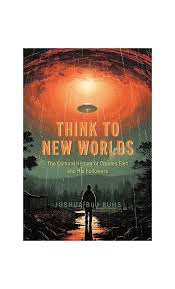
While there’s already a decent biography of Charles Fort, Jim Steinmeyer’s The Man Who Invented the Supernatural (2008), Joshua Blu Buh’s 2024 book Think To New Worlds: The Cultural History of Charles Fort and His Followers extends the study past the individual to his long-term influence. Fort, who died in 1932, was a self-taught scholar of reported anomalies he compiled from voluminous reading of newspapers and magazines – rains of fish or frogs, mysterious objects in the sky, inexplicable disappearances, and so on – which inspired a posthumous “Fortean Society” with members in many countries. Buhs traces the strange, subtle legacy of Forteana across the Twentieth Century, some of it provocative and most of it perfectly harmless, although, in the end, the author acknowledges its damaging impact that’s still felt today.
In an age when scientific rationalism seemed to promise a prospective solution to every social, economic, and political problem, the Forteans offered quiet caveats. How does science account for sightings of sea serpents, or eyewitness reports of inanimate things moving of their own accord? Why does the scientific community ignore the natural oddities that seem to defy the laws of physics or biology? Who gets to decide what’s science and what’s mysticism, anyway? With little formal training or academic credentials themselves, Fort and his followers were an underground resistance to science’s establishment as an unassailable secular religion by the media, education, and government. At their best they had a noble cause, but at their worst they descended into self-delusion, contrarianism, and mere crankery.
In documenting all this, Think To New Worlds incidentally describes the peak decades of print, as a colorful range of characters share and debate their theories in reams of specialized journals, pulp periodicals, amateur “zines,” and private correspondence. A pantheon of published paranormalists are cited, among them Ivan Sanderson (big-time Bigfoot investigator), Vincent Gaddis (who first raised the notion of a Bermuda Triangle), and John Keel (author of occult classics like The Mothman Prophecies and Strange Creatures From Time and Space). Whatever else they were, the Forteans were literate types who trusted the power of the written word; Buhs convincingly argues for their unappreciated connections to the writings of H.P. Lovecraft, postwar science fiction, and even the Beat novels of William S. Burroughs and the poetry of Ezra Pound. Forteana was a kind of lived surrealism, or postmodernism applied in the material world instead of critical studies class, whose inheritance included the druggy counterculture of the 1960s, and the paranoia of the 1970s and beyond.
Unfortunately, the playful, open-to-alternatives stance that characterized Charles Fort’s original books, and later Fortean inquiries into the fields of UFOs and cryptozoology, has since led to the angry rejection of officialdom and objectivity that marks contemporary political extremism (“Hey, has anyone actually seen Barack Obama’s US birth certificate? Just asking the question”). As Buhs concludes, “Fort and the Forteans played their part in the creation of this world; they are not blameless. They eroded the distinctions between truth and falsity, undermined the authority of experts and expertise. They launched a thousand conspiracies into the national consciousness.” And of course most of the Forteans’ conjectures about the nature of reality were eventually obviated by actual scientific progress – there is, in fact, no Bermuda Triangle, and no Bigfoot has ever been found, but satellite mapping, lab-grown protein, and Artificial Intelligence are confirmed phenomena. Still, Think To New Worlds is a fascinating look back at the era when differentiating between the possible and the impossible was a lot more innocent, and a lot more fun.
 George Case, Writer