
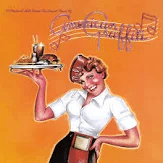
When first pitching his idea for an autobiographical coming-of-age movie to studio executives in 1971, the twenty-seven-year-old filmmaker George Lucas emphasized, “American Graffiti is a MUSICAL. It has singing and dancing, but it is not a musical in the traditional sense because the characters neither sing nor dance.” Finally produced on a budget of less than $1 million and released in the late summer of 1973, American Graffiti was the sleeper hit of the year, was nominated for several Academy Awards (including Best Picture and Best Director, for Lucas), triggered a wave of nostalgic cinema and television series which fondly looked back on the 1950s, and has stood the test of time as both one of the most popular American motion pictures ever and the box-office launch of the director’s multi-billion-dollar career.
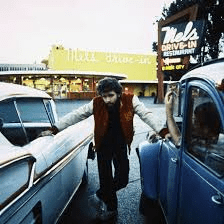
American Graffiti, though, remains the uniquely original musical film George Lucas originally conceived. It was among the first movies, and was certainly the most successful of them, to utilize a collection of pre-existing popular songs for its score. Theme music, of course, had been an integral element of the cinematic art since the arrival of sound on film in 1927, and the most distinguished themes had been retailed as separate recordings for almost as long. But whether as incidental backgrounds or as set-piece performances, motion picture music had been almost always commissioned specifically for one picture; composers, arrangers, singers and musicians were contracted to deliver original content which would be exclusively connected to a single production. Movie versions of stage musicals, too, likewise simply redid the original libretti for the silver screen.
So there was little overlap between the film music which came out of Hollywood and the pop music which came over the radio, and indeed by the advent of rock ‘n’ roll, youth-oriented hits were considered unworthy of quality movies. Eventually the concert documentaries Woodstock and Gimme Shelter (both 1970) had the built-in draw of their subjects, and The Graduate (1968), Easy Rider (1969), and Zabriskie Point (1970), featured songs by contemporary rock artists like Simon and Garfunkel, Jimi Hendrix, and Pink Floyd to attract the burgeoning Baby Boom audience, but the mediums of cinema and Top 40 records had yet to merge into a synthesized whole.
With its end-to-end parade of 45-RPM memorabilia, American Graffiti shattered convention. This groundbreaking innovation not only changed the way pop music was used for films, but also the way film soundtracks augmented the promotion of films themselves. Released concurrently with Lucas’s picture, the two-disc collection properly titled 41 Original Hits From the Sound Track of American Graffiti was itself a commercial triumph which peaked at Number 10 on the Billboard charts and which eventually sold over 3 million copies – a very impressive figure for any individual contemporary artist, let alone for a compilation of material which was pushing twenty years old at the time of issue. Subsequent soundtracks for The Big Chill (1983), Goodfellas (1990), Dazed and Confused (1993), Boogie Nights (1997), and many others, have capitalized on the dual marketing of new movie product with reissued musical classics.
In American Graffiti, the songs are audible as the characters hear them, blaring out from car radios all tuned to the same station or, in one scene, played by a live band at a high school dance (the fictional Herby and the Heartbeats, incidentally, were played by the retro act Flash Cadillac and the Continental Kids, the same musicians who perform “Susie Q” in the Playboy Playmate sequence of 1979’s Apocalypse Now, directed by George Lucas’s friend and mentor Francis Ford Coppola). The audio texture of the movie was crafted by the legendary sound designer Walter Murch, known for his technique of “worldizing” soundtracks so that the dialogue and music have a natural ambience reflecting the physical space in which they’re set – echoing off buildings, fading in and out of reception, and so on.
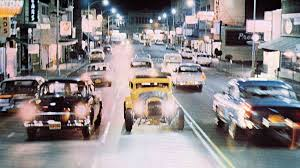
To his great credit, Lucas didn’t try to make the music perfectly complement the narrative at every point, so that the moments when they do are all the more memorable: the montage of cruising cars set to Dell Shannon’s “Runaway”; Curt (Richard Dreyfuss) and the Pharoahs quietly setting up their police car ambush to the vocal rounds of the Del-Vikings’ “Come and Go With Me”; Terry the Toad (Charles Martin Smith) surprised by hoods as the Big Bopper opens “Chantilly Lace” with Helloo, baaby; the climactic drag race set to the pulsing menace of “Green Onions” by Booker T & the MGs. While enormously effective on screen, the music on the album is a faithful reproduction of the original releases in all their mono glory, augmented only by the occasional interjection of clips from the real disc jockey Wolfman Jack’s authentic on-air commentaries.
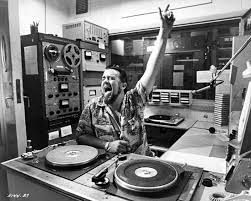
The American Graffiti soundtrack, for all its influence, is a singular album that holds up considerably better than most of the other movie scores which borrowed its format. In its curatorial depth, and in the diversity of its track list, it even stands above many non-film anthologies of period music. American Graffiti is no mere Golden Oldies assembly but a considered and in some places surprising cross-section of pop tunes from the mid-1950s to the early 1960s: doo-wop, surf music, instrumentals, gospel, and primordial rock ‘n’ roll are blended seamlessly together to represent what the filmed story depicts as one long summer night of cruising to the accompaniment of one AM broadcast programmed by one omniscient, omnipotent DJ. The result is somewhere between a “found” concept album and the most widely heard mix tape of all time. Thus, while the movie would definitely suffer without its soundtrack, the soundtrack still succeeds even for those few listeners who haven’t seen the movie.
Indeed, anyone who wants to know something of North American teenage culture circa 1962 should find that American Graffiti is about the best place to start learning. Precisely because Lucas did not select – or could not obtain – the more obvious musical accompaniments for his film, the album offers a more realistic slice-of-life approximation of what adolescents would really have been hearing during the era than a mere historical review ever could. Some songs on American Graffiti were massive, pervasive hits that were still remembered long afterward: Bill Haley and the Comets’ “Rock Around the Clock,” Buddy Holly’s “That’ll Be the Day,” and the Platters’ “The Great Pretender,” for example. But some were curiosities which had faded away shortly after their debuts: the Five Satins’ “To the Aisle,” the Crests’ “Sixteen Candles,” and the Fleetwoods’ “The Great Imposter.” Similarly, a few performers on the soundtrack were stars who had maintained their followings up to 1973 (the Beach Boys, Chuck Berry, Fats Domino), but there were also obscure acts whose fortunes declined once they made the tracks Lucas picked (the Skyliners, the Clovers, the Heartbeats). There is nothing by Elvis Presley, Little Richard, or Jerry Lee Lewis heard in American Graffiti. No retrospective expert could have chosen this set; only someone who had listened to and lived through it would have invested its individual pieces with such meaning.
American Graffiti is not just effective “movie music,” then, but a priceless document of pre-Beatles, pre-Dylan pop that virtually defines the sonic style and lyrical themes which prevailed before the social turmoil of the later 1960s took hold. It isn’t just that the music is more innocent, although it is, but its entire aesthetic – songwriting craftsmanship, studio production, and economic imperative – sharply contrasts with that of subsequent generations. Implicitly, American Graffiti describes the passing of an age as much as it celebrates its pinnacle.
At the same time, the soundtrack established a dangerous precedent. So surely did the movie and the album demonstrate the viability of having radio and jukebox staples serve as indices to particular years or decades, later filmmakers and musical cataloguers adapted Lucas’s scoring technique for their own works, but in doing so they often discarded his delightfully nuanced, personal sensibility. As a consequence, lesser collections sometimes emerged as formulaic and reductive renderings of musical history rather than accurate accounts of it; the requirements of copyright, licensing, and other legal and financial issues dictated which songs were heard in which films, not the visions of their directors or the expectations of their audiences. Nostalgia ceased to be a complicated emotional response and became a convenient selling point. And most pop songs now are punched in on top of the cinematic action rather than emerging organically from within it, and usually in shorthand snippets rather than their entirety. For poignancy and humanity, not many blockbusters are as sensitive, and for eclecticism and taste, not many movie soundtracks are as inspired, as American Graffiti.
 George Case, Writer