
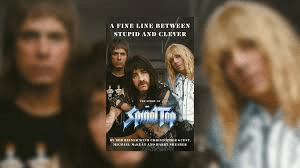
You don’t have to be a fan of classic rock music to enjoy the brilliant 1984 “mockumentary” This Is Spinal Tap – in fact, it probably helps if you dislike it some. But I breezed through director Rob Reiner’s 2025 book A Fine Line Between Stupid and Clever: The Story of Spinal Tap (released to tie in with the debut of Spinal Tap II: The End Continues) and appreciated his insights into the movie’s origins, production, and reception, even though a lot of the backstage details are already known, and even though I and millions of other devoted rock listeners have long recognized exactly what the picture was satirizing. It’s a fun read, but it comes with a painful and very unintended conclusion.
Considering how much irony, parody, and self-referential humor have come to dominate popular culture in the last forty years, I was interested to learn how many studio executives and even original viewers just didn’t get what This Is Spinal Tap was. Reiner recounts his early difficulties in securing even a modest budget for the film, and quotes Christopher Guest (Tap’s lead guitarist Nigel Tufnel) overhearing two attendees at a Dallas premiere: “These guys are so stupid!” Uh, yeah; that’s the whole point. It was in fact the advent of home video that clinched the movie’s enduring popularity, as enthusiasts could savor in the comfort of their living room all its subtle digs at heavy metal, the music business, and documentary filmmaking, which may have first gone over the heads of theatregoers. Much of this was a matter of generations: the older Hollywood bigwigs weren’t versed in the clichés of rock ‘n’ roll the way Boomer talents like Reiner, Guest, and the other actor-musicians Michael McKean and Harry Shearer were, while audiences in their teens and twenties, who’d grown up on Gimme Shelter or The Song Remains the Same, readily understood the jokes. This Is Spinal Tap was meta before meta was a thing, which is itself a meta thing to write. I recall initially seeing it on a double bill with The Last Waltz at a Toronto revue cinema in the mid-1980s, where it seemed that the spaced-out, self-indulgent musings Reiner and his cast improvised for Spinal Tap were only slightly exaggerated versions of similar inanities Martin Scorcese elicited from the Band.
At the same time, while every real act from the rock era has had its career at one time or another compared to the fictional fumbles of Spinal Tap, it’s often forgotten that what made This Is Spinal Tap so comical was that the subject band was obviously flailing, and its music wasn’t very good (at least lyrically: “The words that we used in the lyrics and the titles, that had to be the funny part,” Harry “Derek Smalls” Shearer explained. “But we all agreed that we weren’t going to do bad music”). Reiner recounts how he and his team borrowed elements observed from Uriah Heep, Judas Priest, Saxon, and even the Back In Black-era AC/DC, all of whom have had their personal and professional ups and downs, but none so down as Tap. From this perspective, you can still get into, say, the Who’s The Kids Are Alright film, or a concert video by Black Sabbath or Deep Purple, and not immediately think of Nigel, David, and Derek. Performing “Jazz Odyssey” to a half-empty venue while opening for a puppet show is indeed ridiculous; performing “Stairway to Heaven” at a sold-out Madison Square Garden continues to be awesome. This Is Spinal Tap showed how flimsy the pretensions of rock looked when affected by unsuccessful rockers, but when affected by successful ones, the pretensions are still pretty powerful.
Sadly, it’s now more difficult to laugh along with Spinal Tap in either its 1984 or 2025 incarnation (I haven’t seen the sequel), considering that the celebrated director and his wife were apparently murdered by their son on December 14, 2025; Nick Reiner had grown up in Hollywood and may have been as damaged by privilege and wealth as by inherent mental illness. There’s thus a very dark coda to the film’s affectionate sendup of one particular strain of show business – what began as a knowing wink at fame, or lack thereof, has ended in the horrifying revelation of fame’s worst costs. Both This Is Spinal Tap and the fate of one of its authors tell a story of what penalties the entertainment industry can exact from the artists who supply the product. The first made for a great comedy, the second is a brutal tragedy.
 George Case, Writer