
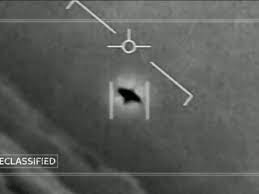
Being skeptical of provocative claims, these days, can make you seem at best a killjoy – “Hey, it’s just harmless speculation” – and at worst a sucker – “Oh, so you’ve bought into the official narrative, have you?” And there are a lot of topics to be skeptical about, from a lot of angles, ranging from the war in Ukraine to the COVID pandemic, and from Canadian Native residential schools to climate change. But one issue has recently obliged skeptics to back up their case in the face of some hard evidence, and that’s the release of government material acknowledging the existence of Unidentified Aerial Phenomena (UAPs), or, as they used to be called, UFOs.
As video footage taken from military planes shows strange objects zooming around the sky, and as various politicians, bureaucrats, and and independent investigators suggest that further high-level records of UAP activity – possibly including contact with their extraterrestrial occupants – have been withheld from the public, a growing clamor of voices is demanding to know the whole story. Just like with other contentious debates, the implication is that there is a whole story: not just an ongoing puzzle that even the experts haven’t quite figured out, but a profound secret that has to be shared for the enlightenment of humanity. And this, I think, is where skepticism is warranted.
If it came out tomorrow that the Catholic Church has for two thousand years been storing the bodily remains of Jesus Christ, or that the Trilateral Commission controls the world from a corporate boardroom, or that the US intelligence apparatus has been holding classified talks with beings from another galaxy, the fact is that not everyone on earth would drop what they’re doing to stand in awe of the new knowledge. Perhaps the fascination with UAPs and possible UAP coverups reflects a hidden hope for a transformative revelation that will upend Life As We Know It, especially if one’s own life is troubled, frustrated, or just boring. The prospective appearance of a new messiah, or the prospective exposure of a huge conspiracy, may offer the comforting thought that all the lingering individual or collective problems we face will be nullified by a remade reality. Were an emissary from a distant planet to land his spacecraft on Parliament Hill, I know I wouldn’t bother going in to work that day, for sure. Yet the potential of such an occurrence to instantly change the entire global order – never mind its potential to happen at all – has been overestimated.
After all, a lot of sudden, dramatic events that might be the product of a clandestine scheme coincide with inexorable changes that were gradually going to happen anyway. Cracking the scheme open can only affect so much. Whether Franklin Roosevelt really knew the Japanese were about to attack Pearl Harbor, we were still going to develop nuclear weapons and nuclear energy; whether a hidden cabal really was behind the assassination of JFK, we were still going to have feminism and the civil rights movement; whether 9/11 really was an inside job pulled off by the George W. Bush administration, we were still entering an era of online social networking; whether national archives will really confirm that vehicles from outer space have been positively identified by senior scientists and security officials, we still have to sort out pollution, poverty, and artificial intelligence. Even the pandemic of 2020-2022, which was certainly a historic episode that swept the world, didn’t completely unite everyone in a mass global confluence of belief and action. So it’s hard to suppose a certified alien invasion would divert every last one of us away from every last one of our earthly preoccupations. What if the news broke while you were exchanging wedding vows? Or giving birth? Or at the bedside of a dying relative? Writing a crucial exam? Tripping on drugs? Making a medical breakthrough? Having sex?
We often think “nothing will ever be the same” after a real or hypothesized turning point, but actually most things do stay the same – people, all seven billion of them, continue with their familiar private routines and hold on to their usual habits of mind, no matter how momentous the history passing over them. Whatever the final truth about UAPs, it probably isn’t so consequential that we’ll have to restart all civilization, let alone our personal affairs or innermost thoughts, from scratch. On behalf of the inhabitants of Earth, I welcome the extraterrestrial travelers, however they’ve made their way to us. In the meantime, I have to go to work.
 George Case, Writer