
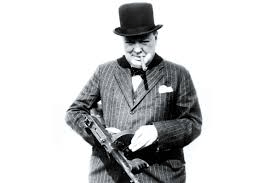
Politics, and the passage of time, have made revisionist history around World War II newly topical. Last year the prominent American pundit Tucker Carlson hosted a podcast with Darryl Cooper, himself a popular podcaster, who has claimed that Winston Churchill was the “chief villain of the Second World War.” Churchill’s record as an unrepentant Anglo imperialist is no secret, and to this day there remain serious criticisms over the Allies’ prosecution of their war against Germany, Italy, and Japan, but Carlson and Cooper seemed to be advancing a more incendiary interpretation, one that goes against most established – or elitist – history. How attentive to such voices should we be?
The question of whether the right alliance fought the right enemies was actually floated during World War II itself and soon after; it was even raised obliquely in the 1946 Best Picture winner The Best Years of Our Lives. Not everyone wanted the UK and the USSR to win, nor Germany to lose. But the dominant narrative of “the Good War” has prevailed for decades. It runs something like: after some painful losses early on, the British, Americans, and Russians rallied to defeat the genocidal fascism of Nazi Germany and the cruel regime of Imperial Japan, saving democracies in western Europe and the Far East, and securing a long planetary peace.
Over the years, though, many qualifying nuances have been added to this heroic story. Some qualifiers were more nuanced than others. Novelist Nicholson Baker’s 2008 nonfiction book Human Smoke: The Beginnings of World War II, the End of Civilization, for example, pointed out rather smugly that the Nazis’ Anglophone opponents were themselves guilty of racism, anti-Semitism, and probable war crimes, whereas Sean McMeekin’s 2021 work Stalin’s War: A New History of World War II clearly showed just how ruthless the Soviet dictator was in manipulating the struggle for his own ends. Elsewhere, Richard Overy, in 2022’s Blood and Ruins: The Last Imperial War, 1931-1945, saw the European colonialism of the 19th and early 20th Centuries as a direct prelude to the global war that officially began in 1939, while David Cesarani, in 2016’s Final Solution: The Fate of the Jews, 1933-1949, suggested the Holocaust was more a “functionalist” corollary of the Nazis’ long-term war strategy than a premeditated goal. These authors offered fresh perspectives and sometimes harsh reminders, but they were not obviously out to overturn the conventional accounts of World War II.
On the other hand, the revisionism that casts Winston Churchill as the war’s main culprit is something different. In this reading, Churchill’s stubborn hostility to the Germans is held to have needlessly intensified the European conflict, thereby forcing Hitler to proceed with his program of genocide. Had Britain not illogically stood by distant Poland in 1939, it’s said, Germany could have crushed Joseph Stalin’s USSR in 1941 or 1942, with a placated England safely at his back, and then merely expelled rather than exterminated Europe’s Jews. Instead the bloodthirsty Churchill and the naive Franklin Roosevelt took Stalin’s side and eventually allowed the Soviets to seize Poland, Hungary, Bulgaria, Romania, Albania, Yugoslavia, Czechoslovakia, and half of Germany itself, for another 45 years, while compelling Hitler to fight and murder right until his continent-shattering end. To the likes of Tucker Carlson and Darryl Cooper, this is the Story The Mainstream Media Doesn’t Want You to Know.
Intriguing. Also simplistic, speculative, and wrong. First of all, Winston Churchill was not the British Prime Minister when war was declared in September 1939, and he’d just been voted out when the Allies moved to finish off Japan in July 1945. Churchill might be blamed for many things, but starting World War II is not among them. More, the Nazis and the Soviets had maintained a non-aggression pact from August 1939 to June 1941 – for almost two years, Britain stood alone against the two biggest totalitarian states in the world, yet when the Germans rolled into Russia, Churchill was blunt in choosing sides: “If Hitler invaded hell, I would make at least a favorable reference to the devil in the House of Commons,” he said. And Hitler did indeed initially hope for a convenient armistice with Britain, except he changed his mind and deployed the Luftwaffe to kill around 40 000 British civilians in the Blitz of 1940-1941. So much for placating England.
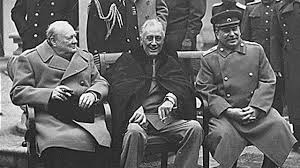
It’s also worth recalling that Hitler’s Germany was a much more conspicuous Bad Guy in the late 1930s than Stalin’s USSR. The western democracies were all too familiar with what they considered German “militarism” from the slaughter of what they still called “the Great War” of 1914-1918, and a generation later, notwithstanding the sneaking sympathies of men like Charles Lindbergh, Joseph Kennedy, and Oswald Mosley, coming to terms with another armed and ambitious German Reich was not an attractive option for most people. On the other hand, the Great Depression had persuaded many in the west that some form of socialism was the key to lasting economic security – while there was a lot of wilful blindness about Moscow show trials and Ukrainian famines, plenty of labor leaders, intellectuals, politicians and regular folks honestly believed that Communism had got something right, and that, in another world war, the Soviets were a preferable ally to the Nazis. Everyone knew about the warlike Germans; Russian expansionism hadn’t yet become an issue. In hindsight it sounds awfully gullible, but at the time, bringing the USSR on to the US-UK team seemed like a reasonable option.
After World War II, similarly, the race-based tyranny of the Nazis was much more offensive to western sensibilities than the class-based tyranny of the Soviet Union (and later, the People’s Republic of China). Social movements on behalf of ethnic or religious minorities could readily invoke the policies of Germany during 1933-1945 as shameful comparisons, but strong unions, generous welfare states, and broad prosperity in the US, Britain, Canada, and other nations made the planned economies of Communism appear just a little less alien. Nazism had ultimately been the project of a lone fanatic, but the principles of Karl Marx had dedicated adherents everywhere. Plus, the horrific revelations of the Holocaust, and Japanese brutality in the Pacific, were more dramatic than the ongoing oppressions and privations experienced by average Russians, Poles, or Chinese. Contrary to what self-satisfied podcasters may say now, the perception of the Good War, and Winston Churchill’s role in its victory, is neither a sentimental myth nor an elaborate fraud.
Like so much discourse in our information-glutted era, the revisionist takes on World War II seem intended more as provocations than sincere scholarship. They’re not meant to increase understanding – they’re meant to generate traffic. You can always stir up controversy and call yourself a red-pilled free thinker by taking an unorthodox position on any subject (Darryl Cooper’s podcast is called Martyr Made), even when you don’t really have much of a case, or even when you don’t really know what you’re talking about. Granted, it should always be possible to introduce contentious but good-faith arguments into hitherto settled debates within science, sociology, or history, and then see how they stand up. But it’s also become very easy to throw outrageous – or demonstrably false – ideas into the public conversation, and then bask in the ensuing notoriety. It works for Darryl Cooper. It works for Tucker Carlson. Hey, it works for the president of the United States.
 George Case, Writer