

My weekday walk to my job site in a large Canadian city takes me through a gauntlet of the urban underclass. Here’s a noisy gaggle of ragged folks clustered around a bottle or two, there’s a man screaming obscenities at an invisible enemy, a woman sits and stares vacantly outside the bank, and over by the mall entrance someone lies comatose and semi-naked. Here come the paramedics, there go the cops. It’s 7:00 AM. Many places across the country and around the world have similar hazards in their downtown areas, where rank-and-file workers and residents are confronted by growing populations of the indigent or unwell: San Francisco, for example, has faced a rise in property crime that has left police and courts virtually ignoring all but the most egregious offences, and in Vancouver last year a “very troubled” homeless man was arrested after randomly attacking two strangers with a knife, killing one and severing the hand of another. Sprawling encampments of tents and makeshift shelters have cropped up in and around middle-class neighborhoods in mid-sized towns as well as metropolitan areas throughout North America and Europe, a problem once thought exclusive to Third World nations in South America or Africa.
The whole phenomenon has been called a crisis, but the responses debated and proposed by public officials aren’t always in line with the private reactions of the public themselves. Why?
It’s not for lack of quantifiable statistics around homelessness, addiction, and mental illness. Different jurisdictions report different results from different policies, and experts point to a range of factors that affect the hard numbers on the streets: the availability of housing and medical services; local economic conditions; the legacies of racism, or post-traumatic stress disorder (PTSD) from military service; the regulations enforced (or not) by municipal authorities. Yet for the ordinary bystanders – the office staff, tourists, students, business owners and other citizens – who pass street people every day, there may be other, more intuitive explanations. We probably wouldn’t turn our backs on the victims of a car wreck even if we thought they’d been driving carelessly, nor would we make our oblivious way past a burning home, on the assumption that the trapped occupants had been playing with matches. For better or worse, however, we put panhandlers and tent cities in a different category. They may be a crisis, but they’re not an emergency.
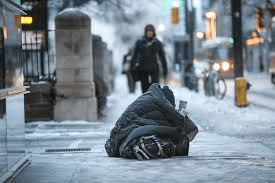
This is, of course, an issue that goes back to Charles Dickens, the class stratification of slums, ghettoes, and shantytowns, and the dawn of the Industrial Age. But one view prevalent in the past is almost never expressed today: the view that the poor are merely lazy. No one now thinks that the man lying in his own waste outside a bus stop is but a bath, a shave, and some can-do gumption away from securing a minimum-wage job and a cheap apartment. The lost souls crowding the subway stations of Toronto or the heating grates of Ottawa are far past even the desire for a stable existence, let alone the ability to attain one. But it’s that distance, and how they came to travel it, that most of us immediately perceive. Sure, someone whose waking life is consumed by the quest for a bite to eat, or enough drugs or alcohol to stave off withdrawals, or simply for a place to take shelter on a winter day, is hardly “lazy.” But we’ve nonetheless acquired an unspoken sense that neither is he just unlucky.
Our compassion fatigue has several sources. First, despite all the advances in psychology achieved over the last few generations, there is still little consensus among specialists or lay persons over exactly how to define mental illness. While it’s easy enough to recognize the schizophrenic who hears voices, or the paranoiac who thinks he’s Napoleon, there are far more individuals whose personalities fall into a vast gray area between subjective eccentricity and clinical affliction. Often the symptoms of an underlying disorder are only manifest in hindsight; not until a full-blown breakdown occurs are histories of self-indulgent or erratic behavior seen to have marked the onset of a medical condition that doctors can formally diagnose. In the same way that nobody accidentally stumbles into work, a home, and a network of supportive friends and family, seldom does anybody make one irrevocable stumble away from them.
In their 2004 book The Rebel Sell: Why the Culture Can’t Be Jammed, Joseph Heath and Andrew Potter suggested that the vague parameters of madness originate in an increased acceptance for unconventional attitudes which may or may not reflect psychological ailments. “Where do we draw the boundary between transgression and pathology?” they asked. “When does ‘thinking outside the box’ shade over into mental illness? What is the difference between engaging in antisocial behavior and rebelling against society? At what point does alternative degenerate into just plain crazy?” Likewise, in 1993’s The Dream and the Nightmare: The Sixties’ Legacy to the Underclass, Myron Magnet ascribed the helplessness of the down and out to the freedoms extolled by the well-to-do: “[I]n addition to trying to liberate the poor and excluded from their marginality,” he wrote, “the cultural revolution sought a second, even more spectacular liberation, which also shaped the fate of the poor, indirectly but far-reachingly. This was the personal liberation that the Haves sought for themselves.”
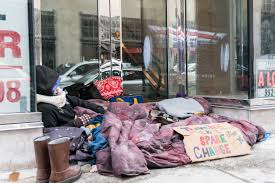
At some level, then, we who daily dodge sidewalk ranters or other public nuisances see them only as extreme specimens – formerly healthy men and women whose idiosyncrasies were never called out early enough to prevent them from deteriorating into self-contained delusions. There may have been a point in their biographies when they could have been steered toward a more rational, practical engagement with the world, but lifetimes of absorbing rhetoric against bourgeois customs and conformity gave them a license to avoid it. The absurdities of modern living to which most people subconsciously adjust became, for the already vulnerable, excuses. They aren’t so much sick, we think, as inadequately socialized.
Once I witnessed a woman escorted by security guards out of a liquor store near my light rail train stop. Suspected of theft (I guess), she yelled and screamed about “racial profiling,” although I couldn’t determine her background in the brief glimpse I had. What would normally be a humiliating admission of disadvantage for some people has become, for others, a bonus box to tick on an application form, or a literal get-out-of-jail-free card. It isn’t so much that the homeless and the jobless are eager to see themselves as unjustly wronged, or that they feel they have ready-made defenses for their worst actions, but that the jargon of “exclusion,” “neurodivergence,” “systemic racism,” “cultural genocide,” “white privilege” and similar terms has filtered down from academics and social welfare advocates to the genuinely poor and genuinely marginal.
Human nature being what it is, such vague but important-sounding language is invoked as a powerful talisman by those who barely understand it, insofar as they can parrot the words before judges or case workers and call them extenuating circumstances. Give a man a fish and you’ve fed him for a day, runs the adage; teach a man to fish and you’ve fed him for a lifetime. But tell a man he’s been historically denied his rightful allocation of fish and you give him an opportunity to have his meals catered forever. This is why even the most sympathetic transit riders or storefront retailers have a limited tolerance for the street people in their midst. Rather than placing them in a special class of victims to whom the rules don’t apply, there’s a suspicion that a vestige of agency – of choice – still drives their conduct.
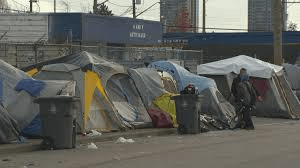
Meanwhile, the wretched squatters and beggars plainly suffering from unchosen mental dysfunction are left untreated by regimes which prioritize care for anyone claiming the effects of abuse, discrimination, disability, or other boutique conditions. Many of them might really deserve a bit of help. But some might give up their appointment at the counselor’s or the therapist’s for those who warrant serious long-term intervention. “The expansion of psychiatric diagnoses leads paradoxically and simultaneously to overtreatment and undertreatment,” Theodore Dalrymple put it in his 2015 book Admirable Evasions: How Psychology Undermines Morality. “The genuinely disturbed get short shrift: those with chronic schizophrenia…are left to molder in the doorways, streets, and stations of large cities, while untold millions have their fluctuating preoccupations attended to with the kind of attention that an overconcerned mother gives her spoiled child.”
Just as there is a twilight zone between the antisocial and the mentally ill, so there is a no-man’s-land between the underground and the underclass. Yes, there are ruthless businessmen and sleazy politicians who still somehow manage to operate within the letter of the law (or go unpunished for operating outside it), but more conspicuous are the downtown denizens who seem to live in a state of permanent petty lawlessness – the true shadow economy of fare evasion, squeegee cleaning, fenced goods, drug deals and other hustles which law-abiding civilians never go near. Most of the homeless, to be sure, are not career criminals, yet it’s easy enough for outsiders to put them in the same class as small-time con artists, gang members, shoplifters, and break-and-enterers – not quite dangerous, but then again not quite innocent, either. They are people with little to lose, for whom a night in jail is probably no worse than a night on the streets. At least, such is the instant judgement rendered by the pedestrians who tread by or over them as they go about their legitimate affairs.
Addiction, too, is another misery that builds in small increments, beginning as a series of bad decisions and narrow escapes that appear entirely voluntary to onlookers. Many people have been drunk or stoned; most of them eventually learn their limits. By the time the addict is crouched in a doorway or huddled under an overpass craving his fix, the rest of us at a glance infer the wild parties, broken promises and broken hearts that led him there. It’s a terrible situation, but it’s not terrible in the manner of a plane crash or childhood leukemia. There remains a popular, common-sense stigma around dependency that no amount of legalism or psychobabble can explain away.

Various regional experiments with sanctioning possession of hard drugs, including cocaine and heroin, have yielded at best mixed results: the public expense of apprehending and incarcerating users has gone down, but the public price of enabling them has gone sharply up. Every day, one sees stumbling, uncomprehending alcoholics, meth heads, crackheads, and opioid users in parks and alleyways; every day, parents find empty bottles, used needles and discarded pipes in playgrounds and schoolyards. How is this an improvement on the War on Drugs? Is surrender the only alternative? In a 2023 New York Times article, “The Hard-Drug Decriminalization Disaster,” Bret Stephens noted that “[A]ddicts are not merely sick people trying to get well, like cancer sufferers in need of chemotherapy…Addiction may be a disease, but it’s also a lifestyle.” When they protest a new safe-injection clinic or halfway house in their neighborhoods, in other words, the clean and sober well know how the clients’ lifestyles brought them there.
The point is that more accommodation, more sympathy, on the part of average people isn’t the answer, just as the question of traffic gridlock isn’t answered by building more expressways. The solution is not for the “fortunate” passersby to feel more pangs of conscience and make fewer shrugs of indifference. Guilt does not trickle down. If there’s a way to address this international crisis, it won’t be by continued submission to it, or by vilifying everyone who’s stopped feeling sorry. The necessary changes may not be political, medical, or economic, but cultural.
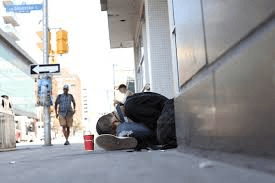
Of course the day-to-day spectacle of the destitute and homeless in our cities is disturbing. Of course it’s a sign of social failure that such depths of hardship are found next to some of our toniest shopping districts, at the feet of our most glittering luxury towers, and in the shadows of our oldest legislatures. Of course it’s sad to see our fellow human beings openly reduced to such degradation. But one tentative initial step to take in alleviating their pain is to acknowledge where some of the responsibility lies, and it’s not automatically with the human beings who – despite living in the same communities, under the same influences, and subject to the same arbitrary fates – aren’t impoverished and homeless themselves.
 George Case, Writer
Sidling up to the hard truth: you can’t save all the starfish…
Lots of starfish washing up these days. Thanks for reading.