
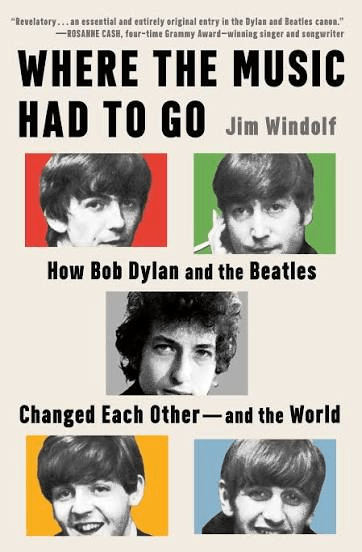
Jim Windolf’s 2026 book Where the Music Had to Go: How Bob Dylan and the Beatles Changed Each Other – And the World is the kind of work I can plow through in two or three sittings, not so much because of the quality of the writing as the familiarity of the subject; I’m the same way with books about World War II, media theory, and the Occult. Windolf has actually produced a decent cultural history, but as I eagerly turned the pages I began to see the limits of the category he’s contributed to, and the category’s possible future.
My perspective here, admittedly, might be a little different than the average reader’s. As the author of several nonfiction titles on classic rock music – including 2008’s Out of Our Heads: Rock ‘n’ Roll Before the Drugs Wore Off, which also examines the Beatles’ and Bob Dylan’s creative and chemical connections – I recognized many of Where the Music Had to Go‘s sources, and Windolf’s research techniques. Put it this way: a Mojo review of my 2007 Jimmy Page biography Magus, Musician, Man said I “deftly synthesize[d] the extant material on Page” and praised it as “a cut above the usual cut-and-paste jobs.” Windolf has dug a bit deeper into his protagonists’ lives than I did with mine, drawing on the archives of the Bob Dylan Center in Tulsa Oklahoma (?!) and his exclusive albeit brief interview with Paul McCartney, but there’s a similar sense that a lot of the quotations and episodes documented here have long been widely known. As a diehard Beatlemaniac and a die-medium Dylan admirer, I found much to enjoy in Windolf’s account. I’m just not sure it told me much that I hadn’t already read elsewhere.
Related to this problem is the sheer volume of books on how other famous people or pop styles allegedly changed the world; Paul Fischer’s The Last Kings of Hollywood: Coppola, Lucas, Spielberg, and the Battle for the Soul of American Cinema is just one recent example. Of course, the influence of any celebrity filmmaker, painter, athlete or musician can be traced in contemporary press coverage and subsequent appraisals, but then again, the flapping of a butterfly’s wings in Brazil can create a devastating hurricane in North America. Who’s to say what changes the world and what doesn’t? In an age where “legendary” status is conferred on personalities whose stardom lasts longer than two weeks, the Beatles and Bob Dylan may not have achieved any more than Lucille Ball, Ozzy Osbourne, or Star Wars, all currently featured in Commemorative Special Editions on my local magazine rack. Dylan and the Fab Four are great, and they definitely won huge followings, but they’re sure not alone in the lucrative field of world-change literature.
This is a fundamental factor in assessing Twentieth-Century entertainment, insofar as the creators had to be publicly identified with their output and the progress of their careers was promoted by the industries in which they operated. It’s by no means all hype – Bob Dylan remains a notoriously private man relative to his iconic image and his catalog of well-known songs – but it can be easy to exaggerate the import of this or that artist or genre by mistaking show business publicity for objective significance. There are some fascinating nuggets of offstage reporting in Where the Music Had to Go, e.g. the edgy 1966 limousine meeting between Dylan and John Lennon that concluded with a near-comatose Dylan being carried back to his hotel room, although even that’s a scene countless non-rock-star twenty-something buddies have enacted after a night of hard partying. Treating every stage of these particular individuals’ personal friendships and growth as a cultural milestone (because someone was there to film, tape, or write about it) glosses over the fact that, as they so often tried to remind their would-be disciples, they were also human beings.
And even granting that Dylan and the Beatles are indeed worthy of the careful cross-referencing and musicology offered in Where the Music Had to Go, I wonder if publishers will increasingly turn to Artificial Intelligence to generate comparable texts: how about 100 000 words on the combined impacts of guitar heroes Jimi Hendrix and Eddie Van Halen, perhaps? Or on the intersecting Hollywood trajectories of Christopher Nolan and Peter Jackson? Or of Seinfeld and Friends? Or on how Lucille Ball, Ozzy Osbourne, and Star Wars changed the world? After all, there are reams of press handouts, recorded interviews, remastered albums, bonus-feature DVDs, critical studies, tell-all memoirs and Wikipedia pages to pull the information from. The results likely wouldn’t be as original, or as insightful, as anything Jim Windolf (or George Case) might come up with. But for the viable markets of fans, collectors, and completists who love hearing the stories and enlarging the myths over and over again, it probably wouldn’t matter.

