
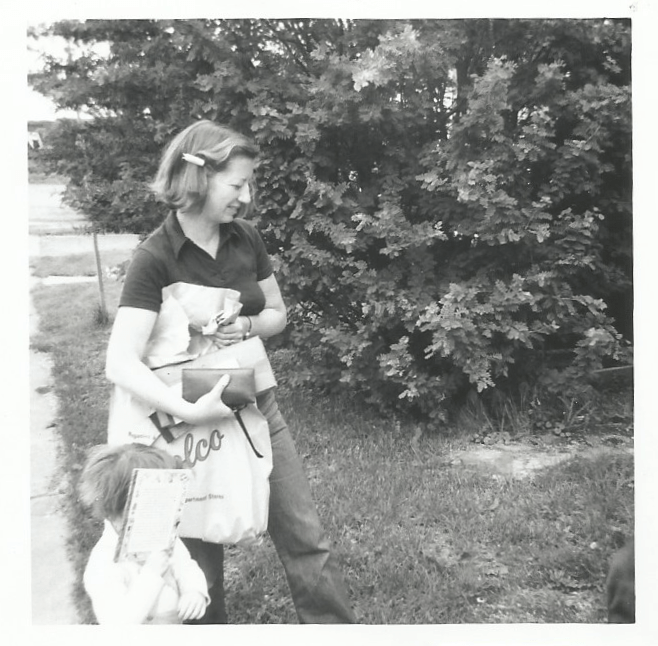
The origins of my career as a writer, such as it is, are probably not dissimilar to many other authors’ – the primary origin being that I grew up in an environment where reading was a common pastime. No doubt there were other factors, including supportive teachers, impactful single works, and role models among my friends, but just having a lot of books, magazines, and newspapers around from infancy onward was the fertile ground in which all the subsequent writerly influences could be nurtured. Today, as commentators reflect on the decline of reading itself in a post-literate age (see the recent Atlantic cover story, “The End of Reading Is Here”), my private memories of what a literate household consisted of may offer an index to how, and how much, things have changed.
I certainly recall being provided with books and comic books from an early age. Some illustrated histories of aviation and World War II are still on my shelves over fifty years since my parents, siblings, or other relatives gifted them to me, and I also own a collection of DC war and horror comics from the 1970s, saved from those times or nostalgically recovered in the ensuing decades. More recently, when my own kids were small, I was delighted to read to them some of the same titles I’d held on to from toddlerhood and after, including Marjorie Flack’s The Story About Ping, George Mendoza’s The Crack in the Wall and Other Terribly Weird Tales, Pierre Berton’s The Secret World of Og, several Beatrix Potters, and my beloved Peanuts anthologies. The Magnum “Easy Eye” editions of H.G. Wells’ science fiction, including The War of the Worlds and The Invisible Man, a Christmas present from Mom circa 1977, have accompanied me across many cross-town and cross-country moves. My tattered paperback of The Exorcist is the same one an older sister innocently handed to me when I was eight; I was a good reader, and she’d never cracked the cover, so what did she know? Let Jesus fuck you.
But even besides what I actually got through myself, during my childhood there was plenty of other reading material chez Case. I’m sure there were Nineteen-Eighty Four and Animal Farm in our house, Lolita I think, poetry collections of Robert W. Service, The Communist Manifesto, T.E. Lawrence’s The Seven Pillars of Wisdom, some Aleksandr Solzhenitsyns, and (to balance them off?) even a few Ayn Rands. A 1968 World Almanac and Book of Facts was kept on hand well into the 1970s. We had Winston Churchill’s multi-part histories of World War II and his History of the English-Speaking Peoples, along with William L. Shirer’s The Rise and Fall of the Third Reich. My father subscribed to a mail-order house called the Military History Book Club, through which we received Edward Jablonski’s two-volume Airwar and Joachim Fest’s Hitler; he also had Paul Brickhill’s The Dam Busters, The Great Escape, and Reach For the Sky, and eventually Paul Kennedy’s The Rise and Fall of the Great Powers. My mother, for her part, seemed to prefer novels by Patricia Highsmith, Raymond Chandler, and Dashiell Hammett, although I also remember that there were often Simone de Beauvoirs, Alice Munros, Doris Lessings, and Margaret Atwoods on her nightstand. For some reason they each got into a lot of espionage fiction by John Le Carré and Len Deighton, and crime pulps by John D. MacDonald, Lawrence Sanders, Joseph Wambaugh, and Dick Francis. Save for Peter Benchley’s Jaws and The Deep (which I managed to read after they were already adapted into hit movies), little of this library interested me back then, except insofar as I could secretly flip through it to find the inevitable paragraphs of Good Parts.
We also had daily delivery of the local newspaper, as well as the Toronto Globe and Mail, and there were always issues of National Geographic, and sporadic copies of Time and its Canadian equivalent of Maclean’s, lying here and there. By the 1980s my parents were subscribing to the Canadian magazine Saturday Night, on whose masthead my same Exorcist sister held a junior position, and the conservative Alberta (later Western) Report. Mom maintained regular mail correspondence with family members out of town or country, and I believe she and Dad both composed occasional letters to Members of Parliament or other officials to express their thoughts about municipal, Canadian, or workplace politics. Most of what they read they had purchased – I can recollect being taken to the public library as a little kid, but I don’t think my parents were regular borrowers, since books and magazines seemed cheap enough (paperbacks went for about two dollars in 1975, when chocolate bars were a quarter) to acquire permanently. The family book shelves in the living room and the bedrooms were always pretty crowded.
And yet – this is the crucial thing – my parents wouldn’t have considered themselves especially “bookish.” From a generation raised before the advent of television, reading to them was simply another form of entertainment. That it happened to be words on a page, rather than images on a screen or music from a speaker, didn’t make it all that much better, as far as they were concerned. Mom and Dad were reasonably well educated, but they weren’t highbrows; at the same time, they were fairly liberal in their opinions, but their standards of taste were shaped during the 1940s. Literacy was for them just a viable alternative to consuming TV, movies, or radio, rather than a civic responsibility, or a social signifier. They were not above sitcoms or 8-track tapes, but they lived on the assumption that most people could and did engage with some kind of text, and that what you read was more interesting than the obvious question of whether you read at all. Their world, in which everybody got their news from a paper, their ideas from editorials, their facts from almanacs, their learning from histories and biographies, and their excitement from thrillers or whodunits, may be gone forever. But it was the world into which I was born, and as you can see, here and in the rest of my bibliography, I still retain my citizenship.


My dad was an insatiable reader, my mom not so much, but there were always books in our house when I was growing up. Dad built bookshelves in every room, but there were overflow cartons of books stuffed in closets, too. My dad traded books with my uncles, and I read it all. No censorship, no book restrictions in our house.
Well, except for my huge collection of comics plus my very own books that nobody got to read but me. My parents signed me up for book clubs and my siblings were younger enough that I could intimidate them into not touching my reading material.
Books were important and valuable and everywhere in my life. I don’t remember a time when I didn’t prefer reading to any other form of entertainment, and that’s true to this day.
Glad you recognized the kind of environment I was talking about, and glad your love of books and reading (and Page, as it were) continues. Thanks for the comment, have a good weekend.