
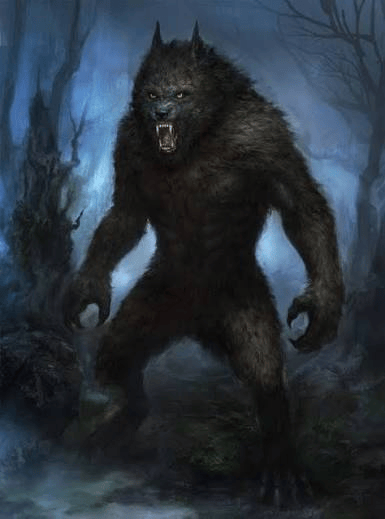
Besides the vampire and the witch, a third staple of horror mythology which has been analyzed for its factual basis is the werewolf. The familiar stories of Count Dracula, flying broomsticks, and hairy shape-shifters may be fictitious, but surely they weren’t invented out of thin air? Tracing the legends’ origins can give us a better understanding of how superstitions develop and how culture works – and maybe even, on a dark autumn evening, give us a bit of a chill.
No doubt the “core” werewolf characteristics which immediately come to mind – full moons, silver bullets, and so on – derive from innumerable depictions put out by Hollywood and comic books. The oldest sources of the belief, however, are far richer and date back much longer. In the first place, the earliest Europeans, who went on to form the kingdoms of the medieval era, would have lived alongside a significant wolf population in a mostly unpeopled continent (Romulus and Remus, the supposed founders of ancient Rome, were said to have been nursed by a wolf). Norse and other pre-Christian tribes used animal skins, including that of wolves, in their religious ceremonies and in combat; large adult wolves are roughly the same mass as grown humans, making the transition of one to another at least a little more plausible during pagan rituals, or on the battlefield.
It’s also reasonable to assume that, in an agrarian society where food came from fields and forests, predation of livestock and wild game by wolves would have been an ongoing concern. Along with bears and foxes, certainly wolves were regular threats to primitive farmers and hunters, not just because the carnivores attacked poultry or venison but due to occasional attacks on farmers and hunters themselves. Even today, rural communities face sporadic dangers from wolves and coyotes – such dangers were multiplied in entirely rural civilizations. Given too everyone’s short life expectancies arising from childbirth, illness, and accident, as well as the inherent violence daily experienced in the butchery of cows, pigs, goats and sheep, the bloody menace of wolves, to our ancestors, was a legitimate, realistic fear rather than an abstract trope of fairy tales.
The notion that humans could become wolves, or wolf-like, may have extended from these facts. To an almost wholly illiterate culture living in remote villages, individual cases of personal eccentricity, isolation, mental illness, and infection by rabies or other communicable diseases could well have been perceived as transformation into a wild beast. Indeed, the modern stereotypes of ignorant hillbillies and country bumpkins, with all their misconceptions about nature and much else, would have applied pretty accurately to the serfs of France or Germany circa 1300 AD. It wouldn’t have been hard to persuade a lonely shepherd, his worldly knowledge limited to a traditional understanding of his place in a divinely ordained feudal order, that an odd or disliked neighbor a few fields over had somehow taken on the qualities of a known peril lurking in the nearby woods. Nor would single people have understood that the effects of hunger or sickness might have provoked in them a delusion they could turn into one of the vicious animals they knew from their own countrysides. In William Peter Blatty’s 1971 novel The Exorcist, these possibilities were succinctly laid out in a passage drawn from the authentic account of Peter Stumpf:
“…I’m just playing devil’s advocate. But one thing that sometimes we tend to forget is that people psychotic enough to confess to such things might conceivably be psychotic enough to have done them. For example, the myths about werewolves. So, fine, they’re ridiculous; no one can turn himself into a wolf. But what if a man was so disturbed that he not only thought that he was a werewolf, but also acted like one?…Well, there’s William Stumpf, for example. Or Peter. I can’t remember. Anyway, a German in the sixteenth century who thought he was a werewolf. He murdered perhaps twenty or thirty young children…When they caught him, he was eating the brains of his two young daughters-in-law.”
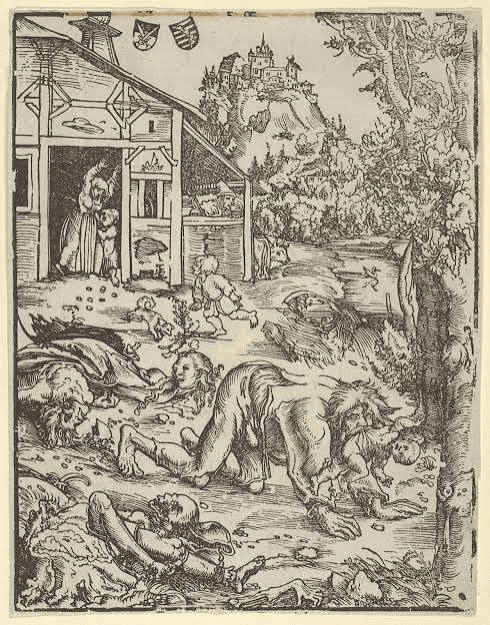
Shapeshifting from one form of life to another is a concept that occurs across cultures, although rarely does any folklore posit a straightforward biological mutation from human to non-human; the oldest known records of antiquity suggest our forebears were still capable of crafting metaphors and fantasies which they knew were not literally true. At the same time, though, genuinely inexplicable phenomena were just as likely to have happened a thousand years ago as today – anomalies that make the news in 2026 (unsolved crimes, human oddities, freak weather events, new sub-species of flora and fauna discovered, et cetera) would have been much more mysterious in the Middle Ages. Most things might now be comprehended in the light of science and rationalism, but even science and rationalism are still stumped once in a while. A thousand years ago, who’s to say that someone afflicted with lycanthropy, or uncontrollable hair growth, or a private insanity informed by religion, malnutrition, and pastoral paranoia couldn’t convince themselves and others that they sometimes changed into a wolf? Something to think about, anyway, the next time you’re on a nature hike and you hear a rustling and growling somewhere in the trees.
Further reading and listening:

