
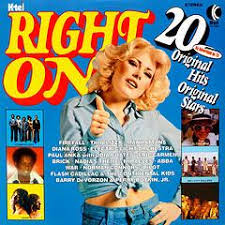
K-Tel was a Canadian company based out of Winnipeg Manitoba, whose commercials for everything from household gadgets to compilation albums became staples of North American television in the 1960s, 70s, and 80s. Engaging the relatively new medium of broadcast TV for the age-old purposes of the hard-sell sales pitch, founder Philip Kives – note the initial – pioneered the development of what we would now call direct marketing, whereby products were retailed to consumers via phone order (“Operators are standing by!”), home delivery (“Not sold in stores!), or bulk merchandising (“Available at K-Mart and Woolco!”). The K-Tel ad format became so successful it was adopted by other companies, and so recognizable it was widely parodied (e.g. Dan Ackroyd’s “Bass-o-matic” bit for Saturday Night Live).
Of particular interest to me are the K-Tel record spots. Repackaging a lineup of proven popular songs into individual long-playing discs, K-Tel could both capitalize on the pre-sold appeal of a lot of one- or two-hit wonders, and prolong their appeal indefinitely. Yes, it was largely disposable work by ephemeral talents, presented in the same cheesy tenor that plugged crappy plastic kitchen and sports wares – but wasn’t that the essence of mass culture in the industrial age? Looking back, the vinyl anthologies, and the sales tactics that hawked them, are an indelible demonstration of how pop music works, economically and emotionally.
Obviously, the attraction of the albums was that they saved consumers the expense of purchasing twenty or thirty separate 45-RPM singles, or of amassing a similar number of entire records comprised of mostly filler except for the one radio cut that had really caught on. While big-name acts like the Beatles or Simon and Garfunkel were priced too high for K-Tel’s licensing department, and didn’t need the extra money, plenty of less established players were happy to re-sell their songs – or didn’t have the contractual clout to stop their corporate masters from re-selling them anyway. Sometimes K-Tel simply bought the rights to reproduce a particular hit (usually in an inferior copy audio-wise), while occasionally they offered artists a quick payday to re-record soundalike versions of pieces still owned, legally, by their original record label. Average punters didn’t care if the K-Tel tracks faded out early, lacked the sonic punch of the official releases, or weren’t always note-for-note reproductions of what they’d first enjoyed years before. They were just happy to get a bargain.
The marketing campaigns of K-Tel and its competitors saturated what was then no more than a ten- or twenty-channel television universe. And mute buttons were a rarity in those days. So even if, or especially if, you never purchased the records, the ubiquitous commercials reinforced the infectiousness of the songs they promoted, by offering up a textual crawl of performers and titles and playing the catchiest few seconds of material already designed for maximum catchiness. The effect was to instil in TV viewers a kind of false memory – Oh yeah, that was a great tune! Who could forget that haunting chorus? – when many of them had in fact never heard the music before. Advertised collections of tracks by single stars like Ricky Nelson or Eddy Arnold had the same quality, distilling whole catalogues down to a series of hooks. By the time people actually heard the complete numbers, they might feel something like déjà écouté, a weird pseudo-nostalgia for radio stations they hadn’t tuned to, sock hops they’d been too young to attend, juke joints they hadn’t ventured inside, and discos they’d always disdained.
Through K-Tel-type advertising, then, millions of listeners benefited from an unintentional exposure to a range of genres they’d otherwise have missed or deliberately avoided. As a kid, the commercials certainly introduced me to pop, country and R&B styles I didn’t find in the family 8-track collection, or even on the local AM dial: Bobby Bare’s “500 Miles,” the Hues Corporation’s “Rock the Boat,” the Hondells’ “Little Honda,” Bert Kaempfert’s “Wonderland by Night,” Jud Strunk’s “A Daisy a Day,” War’s “Why Can’t We Be Friends,” Wayne Newton’s “Daddy, Don’t You Walk So Fast,” Jimmy Gilmer’s “Sugar Shack,” and of course the novelty selections from Goofy Greats, like Roger Miller’s “You Can’t Roller Skate in a Buffalo Herd,” Ray Stevens’ “Ahab the Arab” and Brian Hyland’s “Yellow Polka-Dot Bikini.” The company may be blamed for flogging a lot of junk to an exploited public, but it can be credited with the incidental good of expanding public taste. Mine, anyway.

