
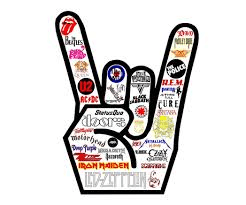
The history of popular music can be traced not just in the evolution of the songs themselves, but in the nomenclature of the individuals and collectives who created them. Often these were simply utilitarian designations adequate for a marquee or the label on a disc: Benny Goodman and His Orchestra, the Miles Davis Quintet, the Quintette du Hot Club de France, the Dave Brubeck Quartet, the Rock and Roll Trio, and so on. Soon, though, ensembles were identified by more colourful descriptors that characterized the music and the musicians, like Louis Armstrong and His Hot Five, the Four Freshmen, or the Four Lads; some of these even had unfortunate racial implications, like the Ink Spots and the Crows. By the advent of the rock ‘n’ roll era in the 1950s, trademarked group names were crucial in distinguishing lineups and styles: the Platters, the Flamingos, the Crests, the Safaris, the Crew Cuts… There was also a subcategory based around a leader (usually a vocalist) and supporting players, in which the backup members were named in echo of the star attraction, e.g. Bill Haley and the Comets, Dick Dale and the Del Tones, James Brown and the Famous Flames, and lesser-known outfits like Neil Christian and the Crusaders, featuring a young Jimmy Page, and the fictional Otis Day and the Knights, from National Lampoon’s Animal House.
In rock and soul’s peak years of the 1960s and 70s, band titles quickly evolved from relatively straightforward plurals (the Beatles, the Beach Boys, the Temptations, the Allman Brothers, the Eagles) to singular, surrealist nouns (the Who, the Jimi Hendrix Experience, the Clash, the Jam), and then to fully abstract language which nevertheless became uniquely associated with particular acts: Iron Butterfly, Tyrannosaurus Rex, Jethro Tull, Parliament, Nazareth, Rush, Kiss, et al. What exactly was an Aerosmith, or a Fairport Convention, or a Procol Harum, or a Steely Dan? You knew it when you heard it. A similar transformation occurred in the identifiers of sports teams, which went from obvious combinations of home town and presumably local athletes – the Boston Celtics, the New York Yankees, the Toronto Maple Leafs – to, more recently, regional or conceptual adjectives like the Minnesota Wild, the Colorado Avalanche, and the Utah Jazz. It’s a measure of how famous some of these organizations became that mentioning a species of insect, for instance, will today conjure up an image of four mop-tops from Liverpool, or that references to German dirigibles bring to mind Seattle mud sharks and defenestrated televisions as quickly as they do the Hindenburg disaster. And try Googling the acronym for “Alternating Current / Direct Current” as it pertains to household appliances. You’ll be instantly steered onto the Highway to Hell.
I’ve always gotten a kick from the way fan communities will give their favorite bands a diminutive that only the truly devoted recognize. Some group names can’t really be abbreviated – however much you may love the Police, U2, Queen, Cream, Heart, or Yes, there’s no more familiar way to cite them in your pantheon. But dedicated followers don’t need to specify their loyalty to the (Rolling) Stones, the (Tragically) Hip, the (Grateful) Dead, the (Sex) Pistols, (Judas) Priest or (Iron) Maiden – what other Stones, Hip, Dead, Pistols, Priest and Maiden can there possibly be? Casual listeners won’t understand. “Nick Mason was the drummer for what act?” “Floyd, of course.” “Who performs ‘The Rover’?” “Zeppelin, dude!” “I’m not familiar with ‘The Needle and the Spoon.'” “Skynyrd, man!” Radio deejays have the lingo down pat: “Don’t go away, we’re rolling some Doobies.” “Here’s ‘Kickstart My Heart’ by the Crüe.” “Up next, some classic Sabbath.” Longer band names get reduced to a shorthand almost everyone will recognize, like CCR (Creedence Clearwater Revival), CSNY (Crosby, Stills, Nash, and Young), GnR (Guns n’ Roses), AIC (Alice In Chains), and BTO (Bachman-Turner Overdrive). The use of initials can be confusing, though – to this day, when I skim a news story about the Bank of Canada, I’m momentarily surprised to learn that Blue Öyster Cult has decided to lower interest rates.
The classic rock argot, especially as used online, now extends to songs and players as well as band names. A Led Zeppelin set list will confirm that the quartet closed a show with WLL, STH, and RnR as an encore; there should be no need to explain that they played “Whole Lotta Love,” “Stairway to Heaven,” and “Rock and Roll” (from LZII and LZIV, respectively). If you have to be told that the Glimmer Twins are Mick Jagger and Keith Richards, you’ll be kicked off the STP. Likewise, if you can’t tell the difference between the Boss, the Beast, the Professor and the Ox, you have no business attending a concert at MSG. Since 1964, millions of Beatlemaniacs have sworn their undying worship of JPGR, while blues buffs know that the late great SRV was a brilliant guitarist, prog-rock audiophiles venerate the sound of DSOTM, and Southern rock fans still mourn the tragic 1977 death of RVZ. You can no doubt find this sort of specialized vernacular in other genres, and indeed in many fields besides entertainment, but it’s a measure of popular music’s influence over the last hundred years that the songs and the artists have affected not just how we hear, but how we speak, write, and think. Only occasionally have I failed to crack the codes, as when I read a Youtube comment: EVH=GOAT. Eddie Van Halen a goat? How dare you, sir, he was the Greatest Of All Time!

