
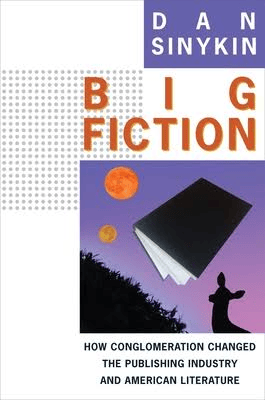
As someone whose working life has been largely spent in book stores and libraries, and who’s built a sideline career as an author of titles issued by small and medium-sized presses, I read Dan Sinykin’s 2023 book Big Fiction: How Conglomeration Changed the Publishing Industry and American Literature from the perspective of an almost-insider. As someone who doesn’t read a lot of contemporary novels, many of the names and titles which Sinykin cites – including Toni Morrison, Don DeLillo, Cormac McCarthy, David Foster Wallace, along with more obscure figures and their works – didn’t resonate much, but I recognized the culture that fostered them, and I came away with some new insights into how the business itself has changed.
Big Fiction, released by Columbia University Press, is probably best appreciated by scholars of the medium. There are some brief discussions of mega-bestsellers like Stephen King, Danielle Steel, and Michael Crichton, but more of the book is devoted to the industry politics surrounding agents, critics, editors, and promotional staff who won’t be familiar to average readers. Yet that seems to be Sinykin’s point: from the 1960s onward, the genteel field of publishing underwent as much of an economic and social transformation as the flashier broadcasting, film, and recording sectors. All of these enterprises, it seems, were driven by financial pressure, changing popular tastes, and shifting technologies to lay off their employees, merge their companies, mass-market their products, and appeal to an almighty bottom line. It happened more quietly in the book business than in the others, but they were all responding to similar forces.
Professional and amateur literary types will be fascinated by the histories Big Fiction offers: the development of trade paperbacks (more prestigious than the almost disposable pocket books, but cheaper and therefore more marketable than hardcovers); the evolution of once-disreputable “genre” crime, western, and horror fiction into respected categories (via writers like Walter Mosley, Larry McMurtry, and King), and the growth of academic creative writing programs (which became a pipeline to publication for a new generation of pre-screened talents who were often inaccessible to mainstream readers). But this last trend also signified the decline of the highbrow bestseller – in Sinykin’s telling, the last novel which was equal parts serious art and serious commerce was E.L. Doctorow’s Ragtime, from 1975. “That year was a peak for literary fiction,” he writes, “the fortunes of which fell steeply as aggressive agents, empowered publicists, and buyers for the new chain bookstores elevated brand-name writers of genre fiction such as Jean Auel, Tom Clancy, Stephen King, Judith Krantz, and Danielle Steel.” Since then, goes the implication, successful authors were less and less likely to be considered important ones. Not everyone will buy that, but there’s no denying the evolution of the form.
Big Fiction doesn’t focus much on the impact of Amazon, or the shrinking audience for any kind of book in the attention-deficient age of smart phones and social media. But its peeks behind the oak-paneled doors of Random House, Penguin, Simon & Schuster, Bantam, Ballantine, and attendant competitors, distributors, and prize committees at their height and after – sometimes drily academic, occasionally gossipy – add an interesting dimension to an oft-told story about the broader drift of the cultural industry as a whole. As Sinykin notes, “…Random House, in 2023, launched a new imprint, Random House Worlds…Here we see another turn in the saga of radicalizing in the conglomerate era. Penguin Random House isn’t creating these copyright and exploiting them, but embracing those of others, the contemporary regime of recycled intellectual property.” Elsewhere he points out, “[Penguin Random House] representatives insisted that success in publishing is totally unpredictable – despite the fact that it is their job to prove the opposite is true, to leverage their immense resources to tame the market, a job they’ve done well.” Beginning in an era when books were a universal form of leisure and learning, and ending in a time when they are increasingly boutique content delivery systems, Big Fiction may be less an analysis than an epitaph.

