
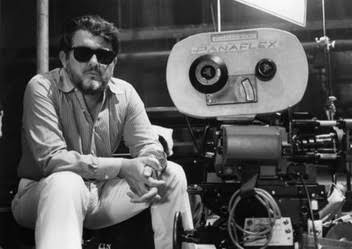
The American filmmaker Walter Hill may be best known for directing the 1982 Eddie Murphy hit 48 Hrs., or maybe the 1988 Arnold Schwarzenegger vehicle Red Heat, but to me his more enduring works were less successful originally yet nevertheless hold up better than the bigger smashes with bigger stars. Hill emerged in the 1970s heyday of the independent auteur – cf. Coppola, Spielberg, Scorcese, Friedkin, Altman, et al – and first won recognition as the screenwriter of outlaw Sam Peckinpah’s gritty The Getaway (1972). The most memorable of his own pictures show the influence of Peckinpah’s fluency with dynamic violence, but they also extend the older cineaste’s central themes of manhood, honor, and an almost elegiac sense of loss. They don’t make ’em like Walter Hill anymore.
Hill’s first really standout work in this vein was The Long Riders, from 1980, a retelling of the Jesse James saga distinguished by an early instance of stunt casting, with real-life brothers James and Stacy Keach as Jesse and Frank James, David, Keith, and Robert Carradine as the James’ compatriots Cole, Jim, and Bob Younger, and Randy and Dennis Quaid as the gang’s sometime associates Clell and Ed Miller. Nicholas and a pre-Spinal Tap Christopher Guest had small roles as the cowardly Ford brothers, Robert and Charlie. But the movie’s effectiveness goes beyond the fraternal ties between the actors. Hill and screenwriters Bill Bryden, Steven Smith and both Keaches portrayed the brothers’ criminal exploits as a final flourish of masculine heartland independence in an increasingly domesticated, policed, and industrialized post-Civil War America – note the symbolic appearance of a primitive “horseless carriage” before the climactic bank robbery.
That final vision of the legendary Northfield Minnesota raid is one of the most compelling action sequences Hill, or anyone, ever put on film. Augmenting Peckinpah-style slow-motion with impressionistic edits and visceral sound effects, the scene marked an adroit counter to the pace of the infamously bloated western from the same year, Michael Cimino’s Heaven’s Gate. The characterizations of the individual robbers – notably David Carradine as the seen-it-all Cole Younger – likewise epitomized what cinema theorist Robert B. Ray called the “corrected genre” approach of American movies in the 1960s and after, updating idealized Hollywood stereotypes of cowboys or private detectives with darker, more graphic depictions of what their lives and deaths would really have been like.
Hill’s follow-up was another peak, 1981’s Southern Comfort. Here he took on the motif of city slickers menaced by depraved backwoodsmen, previously seen in 1972’s Deliverance and 1977’s Rituals, and transposed it to the swamplands of Louisiana, while borrowing a plot roughly copied from John Ford’s The Lost Patrol (1934). It could also be construed as a Vietnam allegory, with hapless American soldiers wandering in an unforgiving wilderness against hostile natives (in this case, French-speaking Cajuns). With a nearly all-male cast led by Keith Carradine, supported by top-tier tough guys Powers Boothe, Fred Ward, Brion James, and Peter Coyote before his career as Ken Burns’ favorite narrator, the testosterone levels here are nearly off the scale – after a recent viewing I had to watch Steel Magnolias to get back in touch with my feminine side. “As an action director, Walter Hill has a dazzling competence,” wrote Pauline Kael in her review. “Southern Comfort comes across with such immediacy that it had a near-hypnotic hold on me and I felt startled – brought up short – when it ended.”
Both The Long Riders and Southern Comfort benefited from haunting soundtracks of authentic Americana by the great guitarist Ry Cooder; Cooder also had a hand in Hill’s 1986 blues story Crossroads, which culminated in a musical cutting contest between Ralph Macchio and the real-life virtuoso Steve Vai. Crossroads was another movie that only found a modest reception, but the big showdown between the young hero and the heavy metal player from (and in) hell is still beloved by shred fans:
Hill’s work as a journeyman director who scored the occasional unexpected box-office smash recalls the trajectories of filmmakers from cinema’s studio era, like Raoul Walsh and Howard Hawks: prolific enough to pick out recurring techniques and trademark devices from a range of films, but maybe not consistently brilliant across all of them. Other of Hill’s movies are The Driver (1978), a no-frills crime drama with Ryan O’Neal and Bruce Dern; The Warriors (1979), at the time controversial for its scenes of gang warfare that spurred copycat episodes in theatres; Extreme Prejudice (1987), an almost ludicrously macho shoot-’em-up with Nick Nolte and Powers Boothe, only partly redeemed by a topless Maria Conchita Alonso; and Trespass (1992), with Bill Paxton, the dependably scuzzy Will Sadler, and even Ice-T getting in on the gunplay. These aren’t chick flicks. Insofar as the demographics of the audience have changed between the 1970s and today, the peak years of putting brutal conflict among hard men onscreen, which Hill did so well in his prime, are as good an index to that change as any. If he’s not as remembered today as, say, George Roy Hill or Sidney Lumet, let alone Spielberg, Lucas, or Coppola, Walter Hill can still claim to have left behind an impressive body of work. Albeit one riddled with bullets.
Further reading:

