
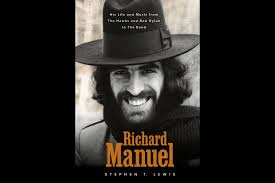
While there are many music legends who died either at the height of their fame or having already passed into permanently iconic status – Jimi Hendrix, John Lennon, Kurt Cobain, Michael Jackson, et al – there are many more whose deaths came later in their careers, well after their success had declined and public attention had moved on. Richard Manuel of the Band, who took his own life in a Florida hotel in 1986, at the age of forty-two, is among the most poignant of this category. Stephen T. Lewis’s 2025 biography of Manuel does justice to the musician’s work and, in a sidelong fashion, to the personal hazards that went with the kind of work he and others like him undertook.
Certainly the Band, nee the Hawks, have won deserved acclaim for a long time. Formed in Canada but building a reputation in the US, they were initially propelled to the spotlight accompanying Bob Dylan on his first post-acoustic tours in the mid-1960s. By the end of the decade their self-made albums Music From Big Pink, The Band, and Stage Fright redefined the notion of rock ‘n’ roll artistry: serious groups were expected to be not merely celebrities or spokesmen but committed craftspeople honing their music in full-time collaboration, individual members living and woodshedding with each other in communal environments where songwriting, rehearsing and recording were the fabric of their daily lives (the Band’s base was in Woodstock, New York). The Band’s sonic identity also solidified the strain of rock that harked back to older traditions of R&B, folk, gospel, or honky-tonk, in contrast to the ephemeral trends of psychedelia or glam chased by other acts. The ensemble epitomized the maturing of the medium, and of the market.
Lewis’s book is at its best analyzing how the Hawks / the Band charted this path. Many music writers fall back on the same old stilted language to describe performances, but Richard Manuel: His Life and Music, from The Hawks and Bob Dylan to The Band draws on a wealth of official and unofficial recorded documentation to inventively evoke the experience of hearing Manuel and his mates in action: “Whether a Rick [Danko] bass run, a Robbie [Robertson] lead part, a Garth [Hudson] mini orchestra, a Levon [Helm] screamer, or Richard moaning an introspective blues, the group was at its best when every position was firing.” “Nightly, a mass of sweltering bodies swarmed the stage, and the Hawks, a musical group of steel-driving men, pounded their sound into shape with 9-pound hammers, while knocking out the sunburned crowds with well-timed and weighted blows.” “‘Kansas City’ is marinated in confident Manuel lead vocals, with Richard sounding the part, kicking back on the corner of 12th and Vine.” “The music is so deeply righteous it becomes a crucible, as if it were able to get up and stroll around the basement, reveling in its divination.” “Richard’s and Rick’s voices pressed together like a flower in a bible, a hippie angel choir that inspired Dylan to make a more concerted effort with his singing.” Unlike Lewis, I’m not quite convinced that the Band’s apprenticeship was much different from that of any well- or lesser-known contemporaries (the Beatles, the Rolling Stones, and many others all honed their chops on the demanding ladder of club gigs), but Richard Manuel effectively demonstrates just what such apprenticeships entail. Aside from providing a sensitive study of his subject, the author here delivers a master class in music appreciation.
And who was Richard Manuel? From the quaint Ontario town of Stratford, he was basically a good-natured guy with more talent than ambition, uninterested in stardom but always up for a party, who was from his teen years swept up into the grueling, exhilarating life of an itinerant professional musician until unanticipated fame and fortune compounded the pressure, and the temptations. A skilled and soulful pianist, Manuel also voiced some of the Band’s best tracks, including “I Shall Be Released” and “Tears of Rage,” but he had none of his bandmate Robertson’s self-discipline, while booze and drugs increasingly distracted him from his responsibilities to a successful group: his deterioration is visible in interview sequences for the 1978 documentary The Last Waltz, and he eventually counted the infamous groupie-addict Cathy Smith among his special friends. Still struggling with his demons after the Band broke apart and partially reformed, by the time of his suicide he was exhausted from the lifestyle, short of money, and dismayed to be playing his old material before half-listening barroom patrons. It’s a trajectory parallelled by numerous other victims of the industry – I can think of Faces singer Steve Marriott, keyboardist Billy Preston, session drummer Jim Gordon, and Manuel’s fellow Band member Rick Danko, to name four – who couldn’t maintain their time at the top and who never recovered from their subsequent crashes. But putting that decline into a long perspective, and listening with a sympathetic ear, Stephen T. Lewis reminds us that Richard Manuel’s musical highs should be remembered as much as his tragic lows.


Such a powerful all time great voice. The Band were the best and ultimately so tragic in so many ways.
Check out the tribute song “Danko/Manuel” by the Drive By Truckers (Isbell on vocals) for a song that covers some of these themes.
Thanks for commenting, I’ll check out that song. Have a good weekend.