
In his 2003 book Ticket to Ride: Inside the Beatles’ 1964 Tour That Changed the World, journalist Larry Kane recounted a disturbing story of accompanying the Fab Four on their private plane while they traveled the United States: he overheard someone among the Beatles and their inner circle casually use the word kike. To his great credit, Kane, who was Jewish, confronted the group. “I won’t stand for that crap,” he told them. “I mean, whoever said it, can’t you think before you talk?” His face-to-face admonishment of otherwise untouchable pop stars at the height of their success was a rare instance of holding even the very famous to ordinary standards of right and wrong.
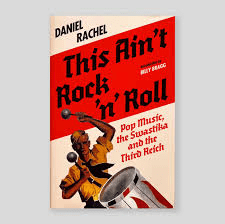
But neither this anecdote nor the reporter’s integrity are to be found in Daniel Rachel’s 2026 title This Ain’t Rock ‘n’ Roll: Pop Music, the Swastika, and the Third Reich. Instead the author presents a compendium of episodes where well- and lesser-known musicians appeared to dabble (or worse) in the motifs of Nazism: Brian Jones, Keith Moon, and Jimmy Page dressing in German military outfits, for example, or Kiss incorporating the SS symbol into their band logo, or Lemmy of Motörhead collecting Nazi paraphernalia, or various punk rock acts like the Sex Pistols and Siouxie and the Banshees sporting swastikas on stage. David Bowie, Roxy Music, Roger Waters, Madonna, Slayer, Michael Jackson, the Human League and Ice Cube also make appearances. All of it is interspersed with historical reviews of actual crimes against humanity committed by the Germans during World War II, as a reminder that Nazis were, in fact, very bad. The result, typified when Rachel juxtaposes details about Auschwitz with a few paragraphs about the Third Reich affectations of proto-punk act the Stooges, is some kind of nadir of Holocaust kitsch.
If the point of This Ain’t Rock ‘n’ Roll is merely to cite all the times celebrated performers did something tasteless or controversial, I can think of a few more entries: Keith Richards’ “Obergruppenführer” t-shirt (denoting a rank in the SS); AC/DC’s 1981 song “Night of the Long Knives” (referencing the murderous Nazi purge of 1934); Guns n’ Roses’ cover of white supremacist Charles Manson’s “Look At Your Game, Girl”; and band names like Sacred Reich and Queensrÿche. It might have been different if the writer at least had the courage to declare flat-out, “Although these are popular entertainers, their appropriation of Nazi emblems – sometimes deliberate, more often thoughtless – means decent listeners should take a principled stand against bigotry by removing them from their record collections and playlists.” Or he might have written another book about every occasion where white performers disparaged or ripped off non-white people, or (an even bigger volume) about every case of exploitation or abuse perpetrated by male artists against female followers. Yet here, Rachel just goes over a catalogue of relatively minor music industry scandals, many obscure to all but the most devoted fans, and smugly implies his disapproval. It’s an exercise in pedantry and moral purism.
For over eighty years, the iconography of Adolf Hitler’s Germany has been as universally recognized as that of world religions, multinational corporations, and global celebrities. Trying to police exactly how any of it can and cannot be represented in a modern context – satirized, subverted, deconstructed, reimagined, or used to provoke – is futile. Documenting the crassest representations in order to compete in some sort of victim Olympics, which may be the underlying agenda of This Ain’t Rock ‘n’ Roll, is cheap. Ultimately, the question to ask would-be arbiters of offensiveness like Daniel Rachel is, Have you ever done anything embarrassing, regrettable, or hurtful? Ever uttered a nasty joke or made a callous remark about others’ suffering? Ever made an impulsive gesture or voiced an ugly slur? Ever been insufficiently respectful of anyone or anything, even by accident or ignorance, in a way that somebody else might take issue with? You haven’t? Well then, to quote Jimmy Page’s old group the Yardbirds, Mister, you’re a better man than I.

