
The archetypes of the vampire, the witch, and the black magician continue to enthrall us, not least of all because their authenticity has been traced back to verified figures from history. Gilles de Rais (c. 1404-1440), Vlad the Impaler (c. 1431-1476), and Elizabeth Bathory (1560-1614) have each been cited as the all-too-real sources of horror legends subsequently adapted into innumerable novels, movies, and other media – but just how real were they? The answers may tell us much about the dynamics of hearsay, disinformation, and the judgements of time.
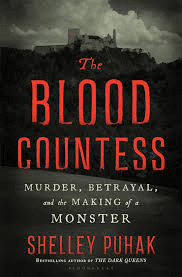
Shelley Puhak’s 2026 book The Blood Countess: Murder, Betrayal, and the Making of a Monster addresses the documentary evidence behind the Bathory story and argues that, far from a depraved murderess who sought to preserve her beauty by bathing in the virginal blood of the hundreds of servant girls she despatched, the noblewoman was herself a victim of political and patriarchal intrigue in the courts of the far-flung Hapsburg Empire during the Reformation. At worst she may have abused some of the young women in her retinue, sanctioned primitive and ineffective medical treatments of her staff and associates, and picked the wrong sides in shifting allegiances among Catholics, Lutherans, and Calvinists, but the lurid images of torture and witchcraft were likely invented by her enemies (vying for her money, her property, and her title) and gradually embellished in the decades after her death.
Puhak’s book is actually a pretty dry account of feuding Seventeenth-Century aristocrats in what is now Austria, Slovakia, Hungary, and Romania, but she does link the Bathory myth to present-day conspiracy theories: the posthumous charges leveled at the Countess, she writes, “would easily be at home in contemporary QAnon chat rooms about adrenochrome theory, which claims that global elites kidnap children to harvest their blood for a particular chemical they need for their youth elixirs.” And I’m sure I’ve read elsewhere that a large volume of human blood does not slosh around like water but would coagulate into messy clots and thus, even if the exsanguination of young maidens held any rejuvenating properties (which it doesn’t), it wouldn’t make for a convenient bath.

Similar exaggerations have been ascribed to the popular perception of Dracula (himself an indirect but much-noted relation to Elizabeth Bathory). While Vlad the Impaler’s tally of as many as 100 000 brutally executed people is broadly confirmed by scholars, it’s been pointed out that such massacres as he ordered were almost common for the era. In the 1973 book Dracula: A Biography of Vlad the Impaler, Radu Florescu and Raymond McNally qualified, “Mass killing of political opponents and the creation of a new loyal nobility was the only acceptable method of meeting the combined danger to authority and consolidating central power…Although Dracula seems to have suffered from ‘a bad press’ already in his time, most of his so-called acts of atrocity were not, at least qualitatively, very different from that of other despots of the Renaissance period.” For context, as well, both Dracula and Elizabeth Bathory have been situated on the ramparts of Christian Europe under threat of violent Muslim invaders from the east – an extenuating circumstance still recognizable in our own century.
Some say even Gilles de Rais, often considered a model for the Bluebeard fable, was coerced into his horrific confession of mass child rape and murder. Though de Rais’s trial, conviction, and execution were duly recorded, later research has suggested that he too, like Elizabeth Bathory, was really targeted by competing nobles looking for a conclusive way to claim his land and wealth, and that the graphic testimony of pedophilia, sexual sadism and conjuring the devil on his French estate of Machecoul were concocted by his persecutors for him to sign under duress. It’s unlikely the real truth will ever be known, but while most references still note the infamous cruelties for which de Rais is remembered, many acknowledge the various inconsistencies surrounding the standard narrative, and the miscarriage-of-justice angle persists.
In each of these cases, then, two contemporary strands of thought have emerged. One holds that Vlad the Impaler, Elizabeth Bathory, and Gilles de Rais can now be diagnosed in pathological terms: they were not agents of supernatural evil but sick people afflicted by specialized forms of mental illness, through which they derived gratification by inflicting pain on others (one author has maintained that Gilles de Rais, who fought alongside Joan of Arc against France’s English enemies, suffered from Post-Traumatic Stress Disorder). In this reading, the perpetrators were essentially prototypes of modern serial killers, albeit acting in much different societies than our own. The other interpretation, such as Shelley Puhak’s in The Blood Countess, is that the “crimes” – long predating the impartial legal systems and forensic criminal investigations we take for granted – never happened at all but were fabricated for others’ advantage. So perhaps all the Gothic scenarios of vampirism, sorcery, and bloodbaths derive from mundane, even harmless realities whose exonerating facts are forever lost to us. Let’s hope so.

